
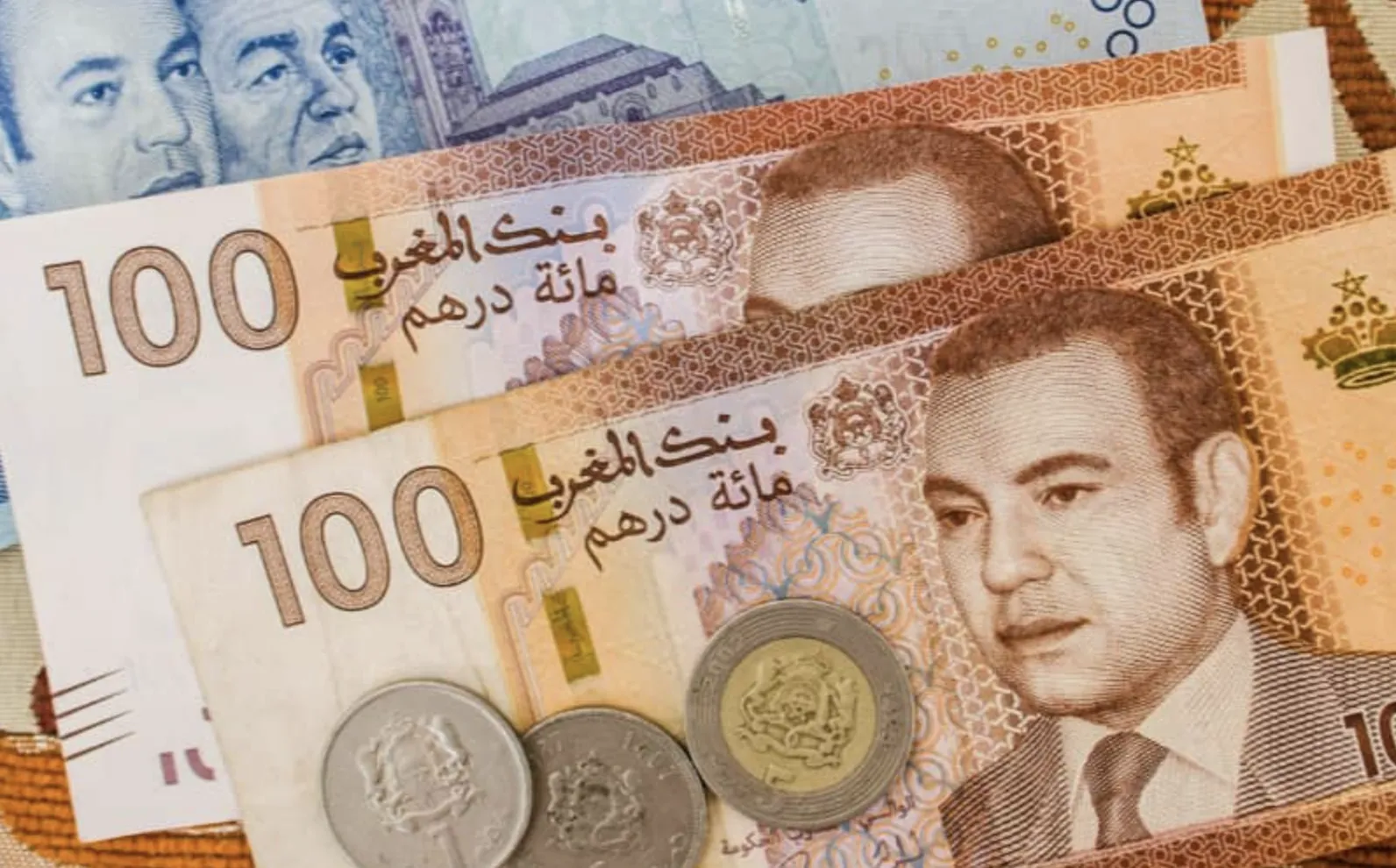
Why the dirham is a closed currency
Morocco controls its exchange rate and restricts how dirhams move across its borders, which makes the MAD a closed currency. In practice, banks and bureaux back home either won't sell you dirhams at all or will offer a tiny amount at a punishing rate. You're also technically limited to carrying only a small sum (a few thousand dirhams) in or out.
The upshot is simple: don't waste time hunting for dirhams before departure. Bring a modest float of euros, dollars or pounds — a fair amount of cash to exchange in case a card fails — and plan to get the bulk of your spending money once you've landed. It feels backwards if you're used to pre-loading currency for other trips.
In Morocco, though, the airport is genuinely the right place to start, not a fallback. Knowing this ahead of time stops you overpaying a home bank for the privilege of bad euros-to-dirham math.
The exchange rate and divide-by-ten maths
The dirham trades at roughly 10.8 to the euro, near 10 to the US dollar, and around 12.5 to the pound, with small daily drift. For day-to-day sanity, the euro relationship is the one to internalise: divide a dirham price by ten and shave off a little. A 40 MAD taxi is about €3.70; a 120 MAD tagine dinner is around €11; a 600 MAD riad night is roughly €55.
Round prices up rather than down when budgeting and you'll never be unpleasantly surprised. The official rate is set centrally, so the spread between buying and selling is narrow at regulated desks. You're not going to find a dramatically better deal by shopping around between banks. Where you lose money is fees and bad conversions, not the headline rate. Keep a rough running total in your head in euros and you'll spot a tourist-priced quote instantly. It'll be the one where the divide-by-ten answer makes you wince.
Getting cash on arrival: ATMs vs exchange desks
Two reliable options sit in every major arrivals hall. The first is an ATM. Marrakech (RAK), Casablanca (CMN), Tangier, Fes and Agadir all have several, usually from real banks like Attijariwafa, BMCE/Bank of Africa, Banque Populaire or CIH. The second is an official exchange desk. It posts a regulated rate and changes your euros or dollars with no haggling — perfectly fair for a first taxi or a coffee while you find your feet.
What to avoid are the standalone exchange counters and machines run by non-bank operators, whose rates and fees can be noticeably worse than a bank ATM or the official desk. A sensible arrival play: change a small amount (say €30–50) at the official desk if you want instant cash, then draw a few days' worth from a bank ATM once you're past the crush. Both are safe; the difference is a few dirhams in fees, not a scam.
Choosing the right ATM and dodging fees
Not all airport machines are equal. Stick to ones wearing a recognisable Moroccan bank's name and colours, and skip the generic 'cash' or 'currency exchange' machines on the concourse, which layer on heftier charges. Most Moroccan banks levy a fixed fee of about 25–30 MAD per withdrawal regardless of amount. So the trick is to withdraw fewer, larger sums rather than dribbling out cash daily.
Your own bank may add its own foreign-transaction fee on top, which is where a fee-free travel card pays for itself. Daily withdrawal caps are common. Many machines limit you to around 2,000 MAD per transaction, sometimes less, so a couple sharing costs may each need to draw separately. Check your card's daily limit before you travel. And do one quiet sanity check at the machine.
Confirm the amount on screen matches what you intended before you confirm, because correcting a mistaken withdrawal abroad is a headache you don't want on day one.
Always decline Dynamic Currency Conversion
Here's the single most common way travellers quietly lose money in Morocco. When you withdraw from an ATM or tap a card in a shop, the machine may offer to charge you 'in your home currency' — euros, pounds, dollars — instead of dirhams, flashing a helpful-looking conversion. This is Dynamic Currency Conversion, and the rate baked into it is reliably worse than what your own bank would give.
Always choose to be charged in dirhams (MAD). On an ATM screen, that means picking 'continue without conversion' or 'pay in MAD' rather than the option showing your home-currency total. On a card terminal, tell the cashier 'in dirhams' if they ask. The convenience of seeing a familiar currency costs you a few percent every single time, and it adds up fast over a week.
Make 'always pay in local currency' a reflex and you'll keep that money. It's the easiest saving on this whole list and the one most people miss.
The 200 MAD note problem
Withdraw 2,000 MAD and the machine cheerfully hands you crisp 200 and 100 notes — and the 200s are a genuine nuisance. A taxi driver facing a 30 MAD fare, a café owner, a parking gardien, a man selling you bread: none of them want to break a 200, and some honestly can't. You'll get a shrug, a long search for change, or a quiet hope you'll just round up and leave the difference.
The fix is to break big notes deliberately wherever change is plentiful. Supermarkets (Marjane, Carrefour, BIM), pharmacies, sit-down restaurants and your riad on checkout are all good. Ask for your change in smaller denominations when you can. Then hoard the small stuff: a thick wad of 20s and 50s, plus a few 100s, is the currency of daily Morocco. Coins matter too — 1, 2, 5 and 10 dirham pieces cover tips, café drinks and the odd public-toilet attendant. Treat 20s and 50s as precious and you'll glide through transactions everyone else fumbles.
Cash vs card: where each actually works
Card acceptance has grown, but the split is sharp. Reliably card-friendly: mid-range and upmarket riads and hotels, sit-down restaurants in tourist areas, supermarkets, fuel stations, pharmacies, and big-brand shops in the new towns. Reliably cash-only: souk stalls, most cafés, all taxis (petit and grand), parking gardiens, hammams, street food, rural guesthouses, tips, and the small artisan workshops you'll actually want to buy from.
Contactless and mobile payment exist in cities but remain patchy, so don't count on tapping your phone outside a supermarket. The practical rule is to treat cash as your default and the card as a backstop for the larger, fixed bills, where carrying a fat envelope of notes feels uneasy. Keep your card for the riad and the supermarket; keep dirhams for everything that makes the trip.
And carry a little more cash than you think you need on day-trips into the countryside. There a card reader is a rumour, and the nearest working ATM can be an hour away.
Paying drivers — small notes only
Drivers are the sharpest test of your note discipline. A petit-taxi fare across town is 20–40 MAD; a grand-taxi seat between towns might be 70–120 MAD; a negotiated airport run runs 100–300 MAD depending on the city. In every case, pay close to the exact amount in small notes. Handing a driver a 200 for a 35 MAD ride invites the 'I have no change' routine — sometimes true, sometimes a nudge to let him keep the lot.
Keep a dedicated stash of 20s and 50s in an easy pocket, so transport never forces you to break a big note under pressure. Count your notes out as you pay, calmly and visibly, which also heads off the rare change-swap shuffle. Tipping is light and by rounding: turn a 38 MAD fare into 40, a few dirhams more for help with heavy bags.
If you've prepaid a private transfer, none of this applies on arrival. You owe nothing but an optional small tip, which is exactly why it removes the transaction first-time visitors dread most.
A realistic daily cash budget
Planning your withdrawals is easier with rough daily numbers. A frugal independent traveller eating street food and riding taxis can run on 250–400 MAD a day (€23–37). A comfortable mid-range day — sit-down lunches and dinners, a couple of taxis, entry to a museum or two, a mint tea on a terrace — lands around 500–800 MAD (€46–74). Specifics: a tagine or couscous in a tourist restaurant is 70–130 MAD, street food well under 40, a coffee 12–20, a bottle of water 5–8, a monument entry 70–100, and a hammam from 100.
Tips thread through all of it — a few dirhams here and there. Add it up, and a couple should comfortably plan on drawing 2,000–3,000 MAD every two or three days. That also keeps ATM fees down. Carry the day's cash in a front pocket and leave the rest in your room safe, rather than walking around with a week's spending on you.
Leftover dirhams, receipts and reconverting
Because the dirham is closed, those notes are nearly worthless once you're home, and banks abroad won't touch them. So spend down or reconvert before you fly. Aim to land your last day with just enough for the airport. Whatever's left, change it back to euros or dollars at a bank or exchange desk before security. Here's the catch travellers miss.
To reconvert, you're often asked to show the original exchange or ATM receipts proving you obtained the dirhams legally. You can also usually only buy back up to a set share of what you exchanged in. So keep every receipt from the moment you arrive. Airport exchange desks landside will reconvert leftover cash, though rates on the buy-back are less generous, so don't deliberately over-withdraw on your last days.
A neat trick: spend the awkward small notes and coins on water, snacks or a final coffee, and reconvert only the clean larger notes. Counterfeit checks apply on big notes too. Desks may inspect 200s closely, which is another reason to keep your cash in smaller denominations.
Fee-free cards, Ramadan hours and counterfeits
A few practical edges. Travel cards like Wise and Revolut give near-interbank exchange rates and refund or waive the foreign-transaction fee your high-street bank charges. Pairing one with a normal card (kept separately as backup) is the cheapest way to spend. You'll still pay the Moroccan ATM's own ~25–30 MAD fee, but you avoid the extra few percent on top.
Carry two cards from different networks in case one is declined or eaten by a machine. On counterfeits: fakes mostly circulate as 200 MAD notes. Glance at the security strip and feel the paper on big notes, and prefer notes handed to you by banks and ATMs over change from a stranger. During Ramadan, bank and exchange-desk hours shorten and shift.
Many close earlier in the afternoon and the rhythm slows around iftar, so draw cash earlier in the day and don't leave a big withdrawal until evening. Outside Ramadan, airport ATMs and desks run long hours. A city bank branch, though, keeps ordinary office times, closing midday-ish on Fridays in places.
- Withdraw a few days' worth at once to dodge repeat ATM fees (~25–30 MAD each), but mind the ~2,000 MAD per-transaction cap.
- Use a real bank-branded ATM, never the standalone 'currency exchange' machines on the concourse.
- Decline Dynamic Currency Conversion every time — always choose to be charged in dirhams, not your home currency.
- Break 200 MAD notes at supermarkets, pharmacies or your riad, and hoard 20s, 50s and 100s for taxis and tips.
- Roughly 100 MAD ≈ €9–10; divide-by-ten and round up to budget on the fly.
- Pair a fee-free card (Wise, Revolut) with a backup card from a different network in case one fails.
- Keep every ATM and exchange receipt — you'll likely need them to reconvert leftover dirhams.
- During Ramadan, draw cash early in the day; bank and exchange hours shorten and shift around iftar.