
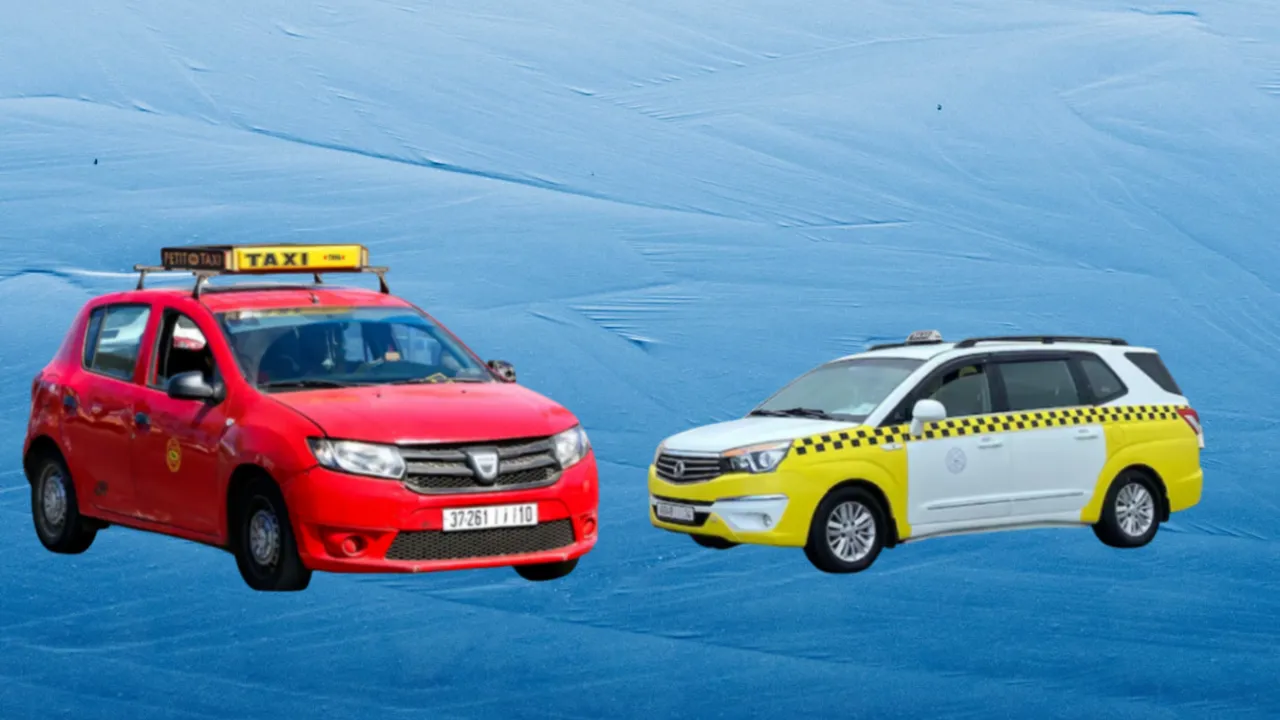
The petit taxi: your in-city workhorse
Petits taxis are the small colour-coded cars — beige in Marrakech, red in Casablanca, blue in Rabat, ochre in Fes. They're limited to three passengers and to trips within city limits. They have meters (compteurs), so the rule is simple. Get in, and before the wheels move, check the meter is running and reads the base fare. A typical cross-town ride in Marrakech runs 20–40 MAD (about €2–4).
Two things trip people up. First, petits taxis are often shared. A driver with one passenger may pick up a second going the same way, and you each pay your own metered share — it's normal, not a scam. Second, the meter resets cheap, so short rides feel almost free. Tip by rounding up rather than calculating a percentage.
What you'll actually pay
Rough, real-world numbers help more than theory. A short petit-taxi hop across the centre of any city is 15–30 MAD by day; a longer cross-town ride 30–50 MAD. After 8pm add about half. Common chartered airport runs land around 100–150 MAD in Marrakech, Tangier and Fes. Into central Casablanca, which is further out, expect 250–300 MAD. For inter-city grands taxis, think Marrakech–Essaouira 70–90 MAD a seat, Fes–Chefchaouen 90–120 MAD, Tangier–Tetouan 35–45 MAD.
These shift a little with fuel prices and season. But if a driver quotes double, you're being sized up as a tourist — name a number closer to these and most will agree.
Surcharges that are actually legal
Not every extra is a rip-off. A night tariff of roughly 50% applies after 8pm in petits taxis and shows on the meter as a second rate — it's official. Bulky luggage can carry a small surcharge in some cities. On a few routes a driver may legitimately combine a metered city leg with a flat fee for the bit beyond the city limit.
The honest test is whether it's stated up front. A driver who explains the night rate before you set off is playing straight; one who 'discovers' a surcharge only at the destination is not. When in doubt, ask another passenger or your riad what the going rate is before you flag a cab.
Scams, and how to shut them down
The classics are easy to handle once you know them. Take the 'broken meter' — just decline and take the next cab, as there's always another. Then there's the 'your hotel is closed / fully booked, I'll take you to a better one'. Give a clear, friendly but firm no, repeated once: you have a confirmed reservation and that's where you're going.
The 'my cousin's shop, just five minutes' detour gets the same answer. And watch the change shuffle, where a 100 becomes a 20 in the driver's hand. Count your notes out loud and keep small denominations, so the question never comes up. None of this is common enough to put you off taxis. It's just the handful of moves worth recognising.
Why airports are a different game
City taxi etiquette mostly breaks down at airports. Arrivals sit just outside the metered city zone, drivers know you're fresh off a flight, and the meter rarely makes an appearance. So the airport rank is where tourists most often overpay. You can absolutely make it work. Head to the official rank (not whoever approaches you in the hall), agree the fare against the posted tariff board, and be ready to walk to the next car.
But after a long flight, on a first night, the calmer move is a pre-booked transfer at a price fixed online, with a driver holding your name in arrivals. It costs a little more than a well-negotiated taxi, and it removes the one transaction travellers most dread.
Apps, tipping and paying
Uber pulled out of Morocco years ago. Careem and inDrive operate in a legal grey zone that official drivers resent, and coverage is patchy. It's fine for locals, unreliable for a visitor on a schedule. So in town stick to street taxis, and for airports use a booked transfer. Almost everything is cash: petits taxis and grands taxis don't take cards, so keep dirhams on you.
Tipping is light and by rounding — round a 38 MAD fare up to 40, and leave a few dirhams more for help with heavy bags. Nobody expects a percentage, and on a fair metered ride a small round-up is plenty.
City by city: the quirks that catch people out
Every Moroccan city has its own taxi character. In Marrakech the beige petits taxis are plentiful, but the medina's pedestrian core means you'll often be dropped at a gate and walk in. Casablanca's red taxis share aggressively and the city is huge, so meters and patience matter. The tramway is a clean, cheap alternative for longer crossings. Fes splits into the medieval medina and the Ville Nouvelle.
Because cars can't enter Fes el-Bali, you'll be set down at a gate like Bab Boujloud. Tangier's taxis are straightforward for the short hops between the medina, the port and the beach. Agadir, rebuilt on a grid, is the easiest of all to taxi around — wide streets, clear fares, no medina maze.
- Always confirm the meter is running before the wheels move in a petit taxi.
- Carry 20 and 50 MAD notes; change is a constant friction point.
- Shared grand taxi seats are fixed price — never haggle on those, just confirm the rate.
- Three is the legal limit for a petit taxi; a group of four needs a grand taxi.
- Expect a legitimate night surcharge after 8pm — it is not a scam.
- For airport runs, a pre-booked private transfer often beats the official taxi queue.