
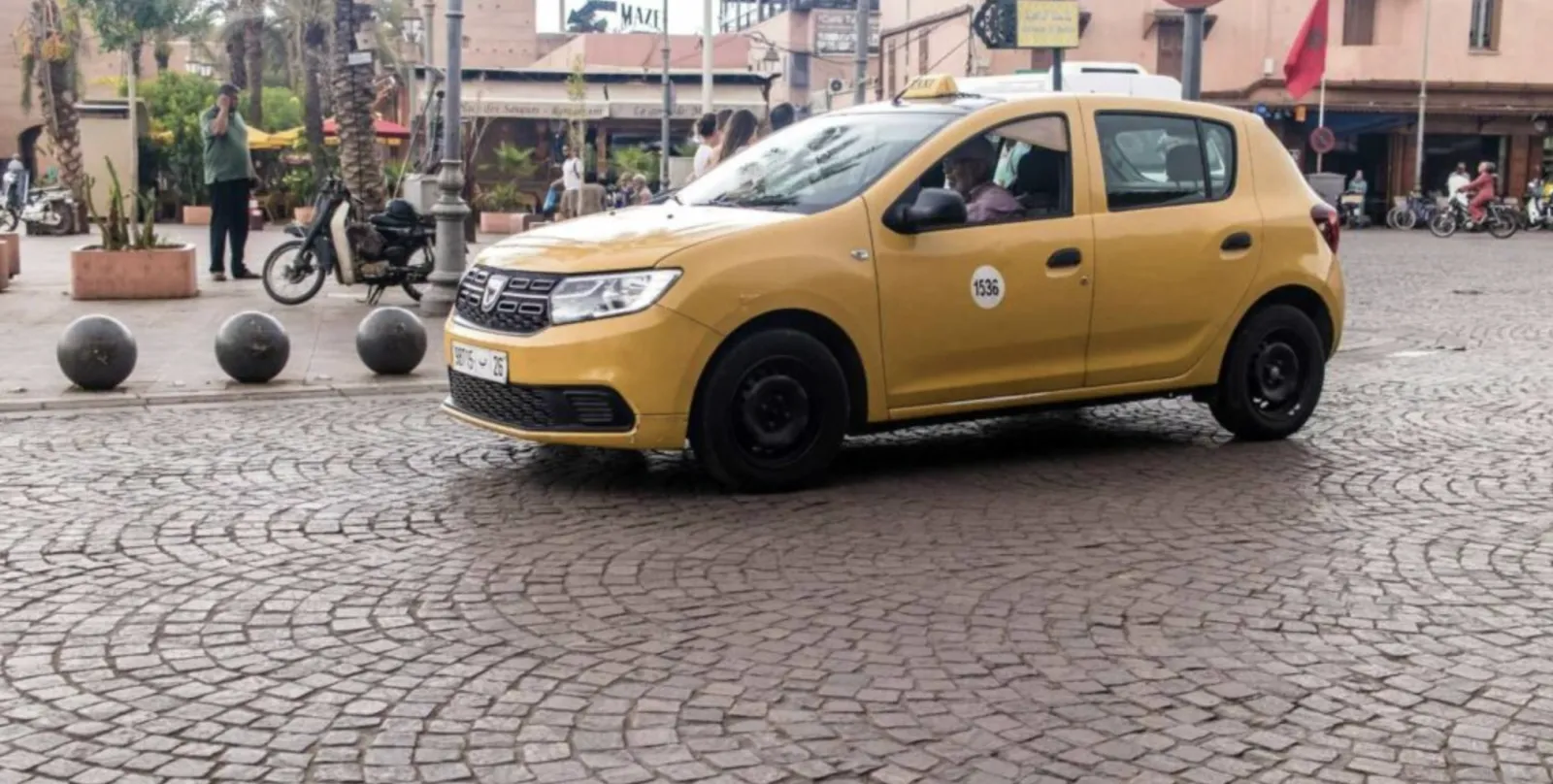
How safe are taxis in Morocco, really?
Set the fear aside first, because it points the wrong way. Violent incidents involving taxi passengers are rare. The petit taxi is a workhorse of ordinary Moroccan life — grandmothers, students and office workers take them dozens of times a week without a second thought. What actually happens to tourists is financial, not physical: a 30 MAD ride quoted at 100, a 'broken' meter, a few dirhams skimmed in the change.
That distinction matters, because it changes how you carry yourself. You are not on guard against a threat. You are simply a customer who knows the price. Walk to the rank with that posture and most of the so-called dangers never materialise. The single best protection is knowing roughly what a ride should cost before you open the door. Every section below circles back to that one fact, because a passenger who names the right number is a passenger nobody bothers to scam.
The 'broken meter' and how to refuse it
This is the move you'll meet most often. The driver waves at the compteur, says it's broken, and offers a flat fare two or three times the real rate. Don't argue the mechanics of it — just decline and take the next cab. In any Moroccan city there is always another taxi within a minute or two. Your willingness to walk away is your whole negotiating position.
If you genuinely can't wait, name a fair number out loud before you sit down ("30 dirhams, yes?"). Don't ask what it costs, which only invites a quote. A driver who agrees to the meter and then 'discovers' it's faulty halfway is doing the same trick in slow motion. Ask him to pull over and you'll finish the ride on the figure you both said at the start. Refusing the meter politely, every time, trains the whole transaction back toward honesty.
"Your hotel is closed" — the commission steer
You give your riad's name and the driver's face falls: it's closed, it burned down, it's fully booked, the road is dug up, he knows somewhere better. Almost none of this is true. He's steering you to a guesthouse or carpet shop that pays him a commission for every tourist he delivers. The patter is designed to make you doubt your own booking.
The counter is boring and effective: repeat your confirmed address, once, in a flat friendly voice — "No, I have a reservation, please take me to [street name]." Don't engage with the story or explain yourself. If he keeps pushing, that's your cue to step out and find another car. Have the exact street and a nearby landmark written down, plus a screenshot of the booking on your phone. That deflates the whole act before it starts.
The cousin's-shop detour and the 'helper' at the door
Two smaller hustles round out the set. The first is the detour: "My cousin has a shop, just five minutes, you only look." Five minutes becomes forty, and the pressure to buy is uncomfortable. A clear "No thank you, straight to the address" — repeated once if needed — ends it. You are paying for a ride, not a tour.
The second appears on foot. An unofficial 'helper' attaches himself as you arrive. He walks you the last fifty metres to your door through the medina, then demands payment for the 'guiding'. If you didn't ask for help, you owe nothing. The easy exit is 5–10 MAD and a firm goodbye, or a calm, repeated "no" if you'd rather not pay at all.
Neither of these is dangerous. They're persistence, and persistence loses to a passenger who simply keeps saying the same short sentence.
The change shuffle, and why small notes win
The most quietly effective trick costs you the most over a trip. You hand over a 100 MAD note for a 40 MAD ride. The driver fumbles, and the note that comes back to your eyeline is suddenly a 20, with a shrug that you 'only gave twenty'. The defence is procedural, not confrontational. Count your notes out loud as you hand them over — "this is one hundred" — so the denomination is established before it leaves your fingers.
Better still, carry a thick stack of small notes: 20s and 50s, plus coins. If you can pay 40 with two 20s, the question of change never comes up. You've removed the entire opening for the trick. Break big notes at a café, a supermarket or your hotel desk during the day. Then you're never forced to hand a 200 to a driver who will, reliably, 'have no change'.
Solo female travellers in a petit taxi
A petit taxi is a perfectly normal way for a woman to get around a Moroccan city alone, by day or in the evening. Most rides are entirely uneventful. A few habits keep it that way. Sit in the back rather than the front passenger seat — it's the local norm for women and it sets a clear, comfortable distance.
Have your destination written down in French or Arabic (or on your phone in Arabic script). That avoids a fumbling conversation about where you're going, and the driver registers immediately that you know the route. Keep your phone out with the map running. Nothing signals 'I'll notice a wrong turn' more plainly. If a driver is over-familiar or a particular car gives you a bad feeling, don't get in, or end the ride early at a busy, lit spot.
There is no obligation to be polite past your own comfort, and the next taxi is thirty seconds away.
Night rides and late airport arrivals
After dark the maths changes slightly, not the safety. Petits taxis run late into the night in the cities and remain fine to use. The legitimate night surcharge (below) is the main difference. Where the calculus shifts is the airport at an unfamiliar hour. Picture stepping off a delayed flight at 1am, jet-lagged, into a hall of drivers who can see exactly that.
It's the worst possible moment to negotiate a fair fare, and it's where tourists most reliably overpay. The clean fix is to pre-book a named driver who waits in arrivals with your name on a sign, at a price fixed online before you fly. You skip the rank, the haggling and the 'no change' routine entirely, on the one night you have the least patience for any of it.
For ordinary late rides within town, a quick fare check before you flag the cab does the same job for a few dirhams.
The legal night surcharge — not a scam
Here's the one extra charge that's completely above board, and it trips up travellers who've been told to suspect everything. After 8pm, petits taxis switch to a night tariff of roughly 50% more. It shows directly on the meter as a second rate (often labelled tarif 2). This is official, set by the authorities, and a driver applying it is playing straight.
The tell that separates legitimate from dodgy is simple. An honest driver's higher number is the meter reading itself, visible to you, and he'll mention the night rate up front if you ask. A scam is a flat fare invented at the destination with no meter in sight. So don't reflexively argue a night fare that's about half again the daytime rate on the compteur. That's the system working as designed, and pushing back on it just sours an otherwise fair ride.
Note the plate, charter, and protect yourself on longer runs
For short metered hops inside the city, you don't need to do anything formal. On a longer ride — a cross-city run, a grand taxi between towns, or any trip where you're chartering the whole car — take ten seconds to note the plate number or the company name painted on the door. Drop it in a phone message to a friend if it makes you feel better.
It's not paranoia. It's the same habit you'd use anywhere, and on the rare occasion something goes wrong it turns 'a taxi' into 'this taxi'. Agree the price out loud before you set off on any non-metered run, ideally a number you checked beforehand. Keep your bag with you rather than fully in a sealed boot if you're nervous about a quick getaway with your luggage.
None of this implies the driver is a threat. It's just the low-cost insurance that lets you relax for the rest of the trip.
City by city, plus the ride-hailing grey zone
Each city has its own taxi character. Casablanca's red shared taxis are the most aggressive — they pick up multiple fares going the same way and the drivers move fast, so insist on the meter and keep your wits. In Marrakech, cars can't enter the medina's pedestrian core. You'll be dropped at a gate (Bab Doukkala, Bab Laksour) and walk in — that's normal, not a dodge.
Fes is the same at Bab Boujloud and the other medina gates. Tangier is mostly easy short hops between the medina, port and beach. Agadir, rebuilt on a grid, is the simplest of all to taxi around. On apps: Uber has left Morocco entirely. Careem and inDrive exist in a legal grey zone that official drivers actively resent, and coverage is patchy — fine for some locals, unreliable for a visitor, and occasionally a source of friction at pickup. In town, stick to street taxis. For airports, a pre-booked transfer.
- Learn the fair fare for your route before you flag a cab — it's the anchor that ends every haggle.
- Carry a stack of 20 and 50 MAD notes plus coins so 'no change' never works on you.
- Count notes out loud as you hand them over: 'this is one hundred.'
- Have your destination written in French and Arabic, and a screenshot of your booking ready.
- Solo travellers, especially women: sit in the back and keep the map open on your phone.
- Save Morocco's emergency number — 19 (190 from a mobile) — though you'll almost certainly never need it.
- For late airport arrivals and night rides, pre-book a named driver instead of negotiating tired and in the dark.
- If a taxi feels off for any reason, don't get in — wait thirty seconds for the next one.