
Where the rail network actually goes
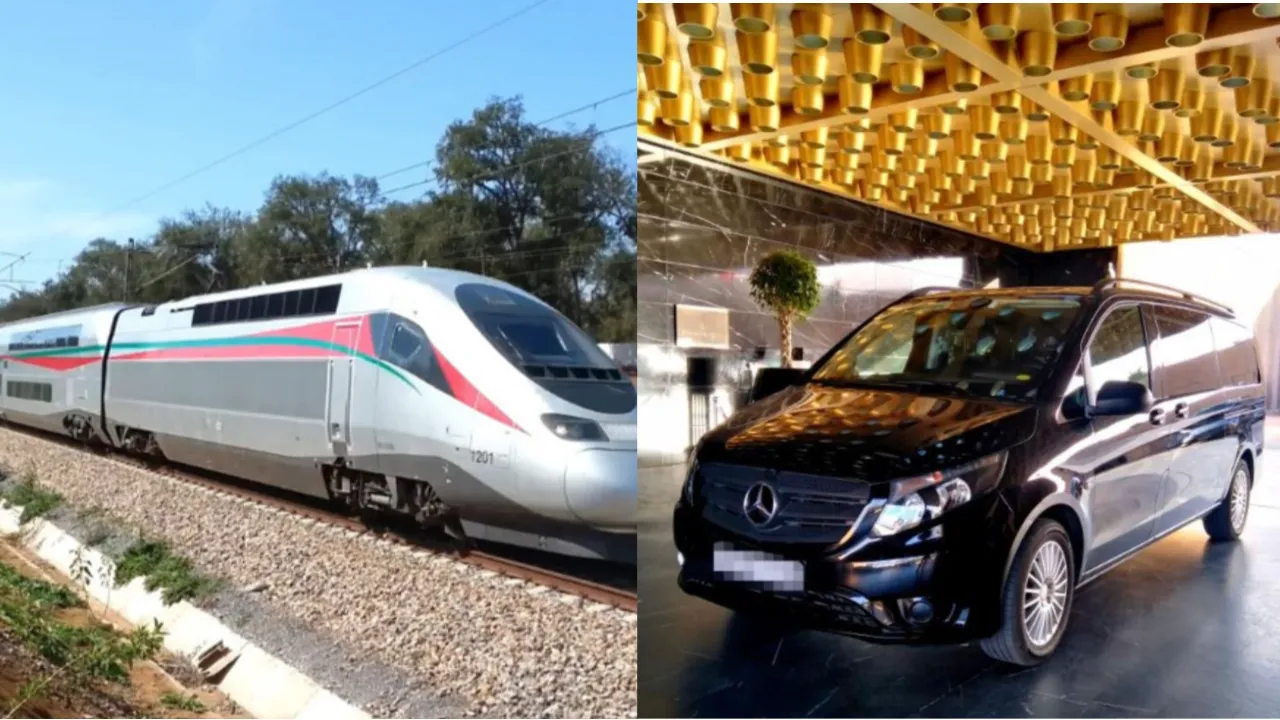
ONCF runs a Y-shaped spine, and knowing its shape decides half your trips. The trunk hugs the Atlantic coast: Tangier down through Kenitra, Rabat and Casablanca. From Casablanca one arm strikes inland to Marrakech; another runs east through Kenitra to Meknes, Fes and on to Oujda. Tangier to Casablanca is now Al Boraq, Africa's first high-speed line, covering 350 km in about 2h10.
Conventional trains handle the rest, frequent and reliable on the busy stretches. Everything else in Morocco — Chefchaouen in the Rif, Essaouira on the coast, Merzouga and the dunes, Ouarzazate, the Dades and Todra gorges, the Agafay desert outside Marrakech, most of the High Atlas — has no railhead at all. If your destination sits on the spine, the train is in play. If it doesn't, the decision is already made for you: a transfer or a coach.
Cost and comfort, honestly compared
Take the two routes most travellers weigh. Marrakech to Casablanca on a second-class train is roughly 100–140 MAD per person for about three hours. A private transfer for the same run is around €150–160 for the whole car, door to door. One or two budget travellers: the train wins, and it isn't close. A family of four: 4 × 120 MAD is roughly 480 MAD, plus a grand taxi at each end.
That closes much of the gap to a single car that never makes you change. On Al Boraq, Tangier to Casablanca is about 150–250 MAD a seat depending on class and how early you book, in 2h10 — genuinely quick and comfortable. Comfort-wise the trains are better than newcomers expect: air-conditioned, assigned seats in first class, a buffet car on the long runs. What you trade is flexibility and the last mile.
The detail that catches everyone: city stations, not airports
Here is the single fact that reshapes the maths. Moroccan trains depart from central stations — Marrakech has Marrakech Ville near the Gueliz district, Fes has Fes Ville, Casablanca has Casa-Voyageurs and Casa-Port. None of these sit at an airport. So a train trip that begins at the airport actually begins with a taxi or shuttle from arrivals to the station, then the train, then a taxi from the destination station to your riad.
That's three legs, two of them taxis, with luggage hauled across two platforms in between. A private transfer collapses all of that into one: the driver meets you in arrivals and drives straight to your door. The cheap headline fare on the train is real, but it's the fare for the middle leg only. Price the whole chain before you decide.
The one exception: Casablanca Mohammed V airport
Casablanca breaks the rule, and it's worth knowing precisely. Mohammed V airport has its own ONCF station directly under the terminal. Trains run into the city — Casa-Voyageurs and Casa-Port — for roughly 40 MAD, with onward connections toward Rabat and beyond. By day this is the best-value airport link in the country: no haggling, no traffic, a fixed cheap fare straight from baggage claim.
It's the one place where the train genuinely competes with a transfer at the airport itself. The catch is the timetable. Departures run roughly hourly and thin out in the evening, with the last services well before midnight, so the under-terminal train only helps daytime arrivals. Land at 1am and the platform is dark — exactly when a pre-booked car earns its fee.
Late-night and pre-dawn arrivals
Trains don't run round the clock, and the timetable bites at both ends of the day. ONCF services largely stop in the small hours and restart early morning. A flight landing at 12.30am or 2am leaves you with no train regardless of route — even at Casablanca. The same constraint works in reverse for departures. If you have an evening flight out of Casablanca and you're coming from Marrakech, you're racing the last suitable train, and a single delay can mean missing your plane.
For any arrival after about 9pm or before 7am, and for tight evening departures, a pre-paid transfer with flight tracking removes the gamble. The driver watches your flight number, adjusts to delays, and is simply there — no last-departure anxiety, no taxi scramble outside a shuttered station.
Luggage, platforms and boot space
Trains in Morocco have overhead racks and end-of-carriage spaces, but no checked-baggage system. You carry and stow your own bags, and you do it under time pressure as the train waits only a minute or two. With two backpacks that's nothing. With four suitcases, a pushchair and a pair of tired kids, the same platform becomes a scramble, and a city station's stairs and crowds don't help.
Then you repeat it at the far end and again into a taxi. A transfer's boot swallows the lot once: the driver loads it in arrivals, you sit down, and it comes out at your door. Surfboards heading to Taghazout, golf clubs, a cello, a month's worth of luggage — anything bulky or fragile tilts the decision hard toward a private car, where space is booked in advance and nobody is rushing you off a platform.
The maths by party size
Run the numbers and a clean pattern appears. One or two people pay one or two train fares — call it 100–280 MAD on a typical spine route — against €150-plus for a whole transfer car. So the train wins comfortably. At three people the gap narrows. At four it often closes entirely once you add a grand taxi at each end (50–150 MAD a pop) and the value of not changing twice.
Five or six travellers usually make the transfer cheaper per head and far easier, since you'd need two taxis or a chartered grand taxi anyway. So the rough rule: 1–2 travellers lean train, 3 is a toss-up that comfort and luggage decide, 4+ or any family leans transfer. Always price the connecting taxis into the train option. Left out, they flatter the railway and mislead the decision.
Mixing both on one trip — the smart play
You don't have to choose once for the whole holiday. The savvy move is to use each where it shines. A common pattern: pre-book a transfer for the stressful legs — the airport arrival, the late landing, the door-to-door run to a medina riad, the off-network hop to Chefchaouen or the desert. Take the train for the easy daytime city-to-city stretches where you're rested and travelling light.
Land in Marrakech, transfer to your riad, explore. Later take the train Marrakech–Casablanca for a day trip, then a transfer onward to Essaouira where no train goes. You get the railway's price on the routes that suit it and the car's convenience exactly where the train would leave you stranded. Booking the transfers in advance and slotting the trains in between is how experienced visitors travel Morocco without friction.
When there's no train: the coach as a third option
Off the rail spine, the choice isn't only train-or-private-car — there's a strong budget middle option. CTM and Supratours run modern intercity coaches to places the railway never reaches: Chefchaouen, Essaouira, Merzouga, Ouarzazate, the Atlas towns. They're cheap (often 80–200 MAD), air-conditioned, with reserved seats and a hold for luggage. On routes like Marrakech–Essaouira or Fes–Chefchaouen they're the standard way solo travellers and couples get around.
What they share with the train is the limitation: fixed stations, fixed timetables, and a taxi at each end to reach your actual accommodation. For one or two people watching the budget, a CTM or Supratours coach beats a private transfer on price. For a group, a late arrival, or a door-to-door run with luggage, the transfer still wins on the same grounds it does against the train.
- Check your destination against the rail map first — off the spine, it's a transfer or a coach, not a train.
- Always add the airport→station and station→riad taxis when pricing the train; they're the hidden cost.
- From Casablanca airport the under-terminal ONCF train (~40 MAD) is unbeatable value by day — but only by day.
- Solo or a couple on the spine? Take the train and pocket the difference.
- Three or more, or any family with luggage? Price a transfer per head before assuming the train is cheaper.
- Flying in after ~9pm or out on a tight evening connection? Book a transfer; the last train may not be there.
- Buy Al Boraq tickets a few days ahead for the lower fare buckets — same train, cheaper seat.
- Mix and match: transfer the hard legs (airport, late nights, off-network), train the easy daytime city runs.