
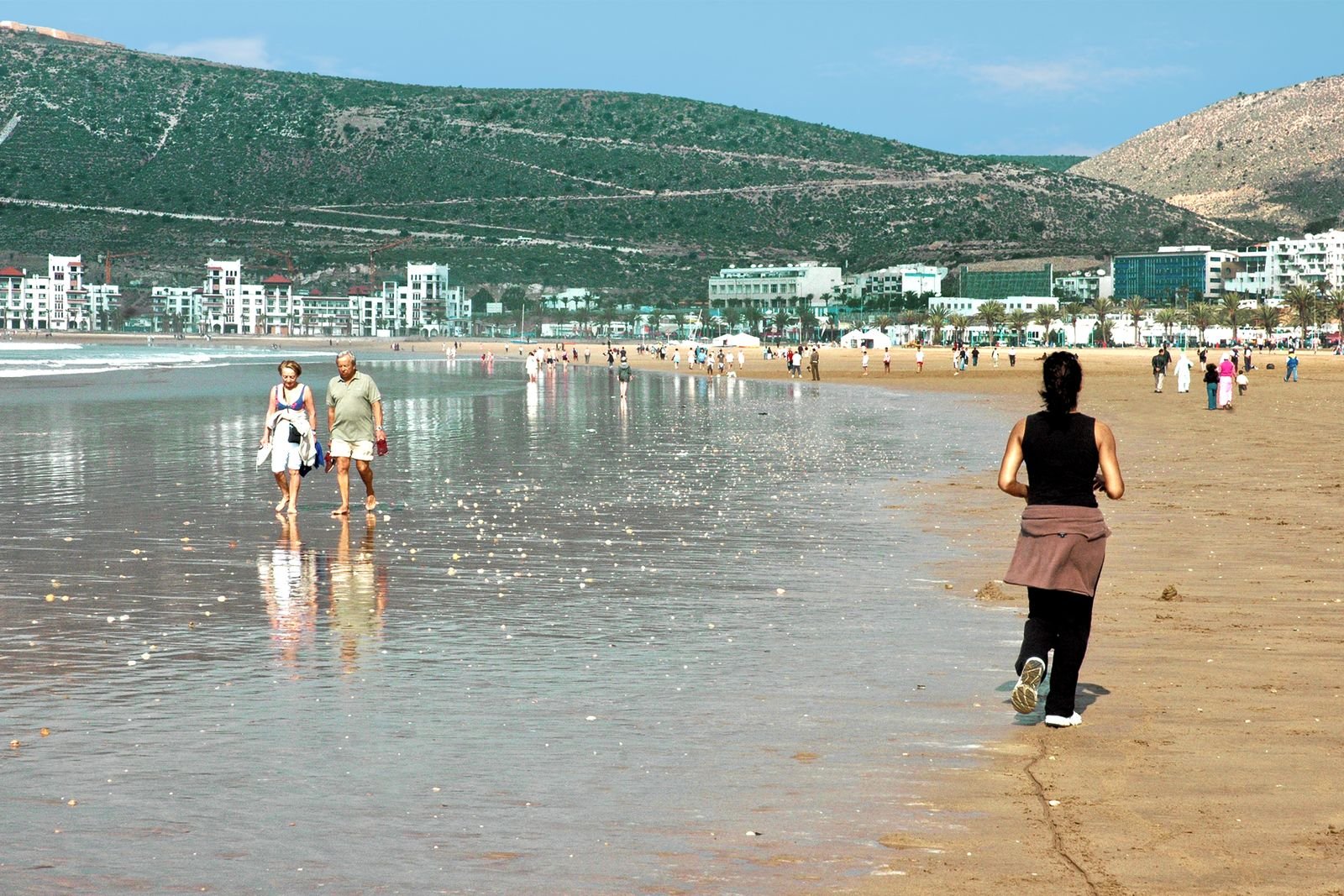
The city with no old town
On 29 February 1960, an earthquake destroyed Agadir in about fifteen seconds and killed something like fifteen thousand people. What stands today was built afterwards, deliberately low-rise and modern, set back from the fault, facing a long south-west-curving bay. That history is the most important thing to understand before you book, because it means Agadir has none of the machinery the rest of this country runs on.
No walled medina, no unmarked riad door, no lane too narrow for a car, no negotiating which bab your driver stops at. The only survivor is the ruined kasbah on the hill to the north — Agadir Oufella — with its inscription reading God, Country, King, now reachable by cable car. Everything below it is sixty years old. If you've read our Fes or Chefchaouen guides and internalised the gate-and-porter routine, forget all of it here.
Be honest about what Agadir is
Agadir is Morocco's beach resort, and it is unapologetically built for package holidays: charter flights, all-inclusives, seafront hotels, promenade restaurants with picture menus, and bars that serve without ceremony. That's not a criticism — it does the job well, and the numbers explain why. The bay faces south-west and is sheltered by the headland, so unlike Essaouira up the coast it's genuinely calm; the sun shows up more than three hundred days a year; and while Marrakech is at 40°C in August, Agadir sits in the mid-twenties.
In January, when northern Europe is dark, it's 20–22°C and sunny. That is the entire proposition. What you will not find is a thousand-year-old city — and people who book Agadir expecting the Morocco of the postcards leave disappointed, not because Agadir failed, but because they booked the wrong town.
The beach promenade: the default choice
The long seafront boulevard behind the sand is where most visitors stay, and for good reason. You step out of the hotel onto a landscaped promenade, the beach is right there, and the restaurants, cafés and bars are all in a walkable strip. Hotels range from mid-range three-stars to large four- and five-stars, most with pools, all with lifts, all reachable by car.
It's the safest, easiest pick: you'll never need a taxi to have dinner, and the beach is a two-minute walk in a swimsuit. The cost of that convenience is that the strip is generic — this could be a resort promenade in southern Spain, and the food skews to what northern Europeans order. It's a good base, not an experience.
The Marina: the smart end of town
At the northern tip of the bay, near the port and beneath the kasbah hill, the marina development is the most polished part of Agadir: white low-rise apartments and hotels around the yacht basin, decent restaurants, calmer, cleaner and noticeably less package-holiday than the main strip. You're a short walk from the quieter northern end of the beach, and close to the fishing port — where, incidentally, the grilled sardines are the best-value meal in the city.
It costs more than the promenade and there's less immediately on your doorstep at night. It's the pick for couples, for anyone who wants a beach base without the charter-hotel atmosphere, and for self-caterers, since a lot of the marina stock is apartments.
Founty and the southern bay: the all-inclusives
Toward the southern end of the bay, the Founty area — sometimes sold as Baie des Palmiers — is where the big garden resorts sit: large grounds, palms, several pools, kids' clubs, and the all-inclusive wristband. It's greener and quieter than the main strip, the beach in front is wide, and if you intend to spend the week between a lounger and a buffet it's comfortable and well run.
It's also further from anything that isn't the resort, so an evening out means a taxi each way, and the all-inclusive model means most people simply don't leave. Book it if the resort is the holiday. Don't book it and then complain that you never saw Morocco — that's a decision you're making at checkout.
Talborjt: where the city actually lives
Fifteen minutes' walk inland from the beach, Talborjt is the rebuilt quarter where Agadir's residents live, shop and eat. There's no glamour and no sea view. There are cheap, decent hotels, restaurants where a tagine costs a third of promenade prices, ordinary cafés full of men watching football, and — the one genuinely great Moroccan thing in the city — Souk El Had nearby, a vast walled market of several thousand stalls selling everything from argan oil to live chickens.
Talborjt is the right call for budget travellers, for people who want to eat well cheaply, and for anyone who finds the promenade sterile. It's the wrong call if you want to fall out of bed onto the beach, and it's a modern working district rather than a picturesque one — this isn't a medina substitute.
Taghazout and Tamraght: a different holiday entirely
Forty-odd kilometres up the coast — about 42 km to Tamraght and Aourir, 48 km to Taghazout, roughly 50 to 60 minutes from the airport — sit the surf villages, and they are not Agadir with better waves. They're a separate proposition: small, scruffy, boho, built around surf camps, hostels, yoga retreats, banana-juice stalls and a permanent population of long-stay Europeans.
The waves are world-class in winter, the vibe is barefoot, the accommodation is cheap, and there's very little to do that isn't surfing, eating or watching the sunset. If you're picturing a hotel with a pool and a promenade, you'll hate it. If you're picturing a board and a beach shack, Agadir's strip will feel like an airport lounge to you. Pick a side before you book — they're 45 minutes apart and completely different holidays.
What it actually costs
Agadir is competitive because it's a volume destination. Shoulder-season, per night for two: a simple Talborjt hotel runs about €20–40; a mid-range promenade three-star €40–75; a good four- or five-star on the seafront with a pool, roughly €70–150; the Founty all-inclusives are usually sold as packages and only make sense priced per person per week rather than per night; and the Marina apartments sit around €60–120.
Taghazout is cheap outside of surf peak — a hostel bed or a simple room for €15–40 — and spikes hard December to February when the swell arrives. Agadir's own peak is the European winter, which is the inverse of the imperial cities: while Marrakech is dead in January, Agadir is full.
Getting there, and why it's the easy arrival
Agadir Al Massira sits about 22 km inland, roughly 25 minutes from the beach hotels — and this is far and away the simplest arrival in Morocco, because there's no gate, no derb and no porter. The car pulls up at your hotel door. The official taxi runs around 250 MAD by day and 350 MAD at night; a pre-booked transfer starts near €20 and removes the rank negotiation, which is the only friction the trip has.
For the surf villages add time: Tamraght and Aourir are about 42 km and 50 minutes, Taghazout 48 km and about an hour, and the coast road north is slow and scenic rather than quick. If you're heading straight to a surf camp at night, that's the run worth booking ahead — the villages are dark, small and hard to find an unmarked guesthouse in.
Who should stay where
Winter sun, easy week, first time in Agadir: the beach promenade. Couples, or anyone who wants the beach without charter-hotel atmosphere: the Marina. Families who want a pool, a kids' club and no thinking: Founty and the southern bay. Budget travellers, food-led travellers, longer stays: Talborjt, and eat at the souk. Surfers and anyone under thirty with a backpack: Taghazout or Tamraght, not Agadir.
Anyone whose real goal is Morocco — medinas, riads, souks, history: honestly, don't base yourself in Agadir at all. Use it as an airport and go to Essaouira, three hours up the coast, or Marrakech, three hours inland. Agadir is where you go for the beach; the country is elsewhere.
The mistakes that spoil an Agadir stay
The big one is booking Agadir expecting Morocco. There's no medina to wander, no souk maze to get lost in, and the promenade could be anywhere on the Mediterranean — arrive expecting Marrakech and you'll spend the week wondering where the country went. The second is the all-inclusive trap: it's excellent value and it also quietly ensures you never leave the compound, so at least go to Souk El Had once.
The third is the sea fog. Agadir mornings are frequently grey and misty — the local brume rolls in off the Atlantic and usually burns off by late morning — and every year people panic on day one that they've booked a washout. They haven't; wait until eleven. And the fourth is assuming Taghazout is a short hop: it's 45 minutes up a slow coast road, not a stroll from the promenade.
- There's no medina and no gates — a car reaches every hotel door. Agadir is the easy arrival.
- Grey misty mornings are normal — Atlantic fog usually burns off by 11am. Don't panic on day one.
- Eat at least one meal in Talborjt or at the fishing port: a third of promenade prices, twice the food.
- Souk El Had is the one genuinely Moroccan experience in the city — go, even from an all-inclusive.
- Taghazout is 45–60 minutes away, not a walk. Decide surf village or beach resort before booking.
- Agadir's high season is the European winter — January is busy and sunny, not dead.