
The only decision that really matters
Forget star ratings for a moment. In Marrakech the quarter you choose shapes the trip far more than the property does, because each one comes with a different set of daily frictions and rewards. The old city — the medina — sits inside a ring of red ramparts, and its heart is Jemaa el-Fnaa, the square that fills with smoke and drums after dark.
West of the walls, Gueliz is the Ville Nouvelle the French laid out in the 1920s: straight avenues, plane trees, galleries and restaurants that take a card. South of Gueliz, Hivernage is a quiet pocket of big hotels and gardens. And fifteen minutes north-east, the Palmeraie is a palm grove of walled resorts and villas. Same city on the map, four completely different holidays.
The Medina: what a riad actually is
A riad is not a small hotel — it's a traditional courtyard house turned inward. The street face is a blank wall with an unmarked door, and everything happens inside: a cool tiled courtyard, usually an orange or lemon tree, four to eight rooms wrapped around it on two or three floors, and a roof terrace where breakfast arrives under the sun.
That inward design is why riads feel like a secret, and it's also why the ground rules are different. Rooms face the courtyard, so sound travels — a lively group on the terrace is audible in bed. Staircases are steep, narrow and tiled, and almost none have a lift. The plunge pool in the courtyard is for cooling off, not swimming lengths.
And many riads don't serve alcohol. What you get in return is a kind of hospitality that no chain replicates: eight rooms, a staff who learn your name by day two, mint tea when you come in off the souks, and a rooftop that goes pink at dusk while the muezzin starts up across the rooftops.
Inside the Medina, the quarters aren't the same
"Staying in the medina" covers wildly different experiences. Mouassine and Dar el Bacha, in the centre-north, are the chic address — beautifully restored riads, the best concept stores, and the souks genuinely at your door, with vehicle access around Bab Doukkala or Bab Laksour. Riad Laarous, further north, is quieter and cheaper for the same fabric. The Kasbah, in the south, is the one I'd point most first-timers to: you're beside the Saadian Tombs and the Badi Palace ruins, the lanes are wider and calmer, and Bab Agnaou puts a car close to your door.
The Mellah, the old Jewish quarter next to the Bahia Palace and Place des Ferblantiers, is similar — atmospheric, workaday, less touristed. Then there's the ring immediately around Jemaa el-Fnaa. It looks ideal on a map and it's the one place I'd hesitate: the square runs loud until well past midnight, and the surrounding derbs draw the highest concentration of would-be guides.
Gueliz: the city that simply works
Gueliz is where Marrakech does ordinary life, and after three days in the souks that starts to sound wonderful. The spine is Avenue Mohammed V, and around it you get pavement cafés, an actual choice of restaurants — Moroccan, Italian, Japanese, decent coffee — bars and wine lists, supermarkets, pharmacies and shops with fixed prices and no negotiation. Rooms are typically modern hotels or apartments rather than riads, which means lifts, reliable air conditioning, space, and a taxi that stops at your front door instead of a gate 300 metres away.
You're 10 to 15 minutes by petit taxi from Jemaa el-Fnaa, or a 25-minute walk. It's also better value per square metre than the medina, and the Majorelle Garden sits on its northern edge. Gueliz is the obvious pick for repeat visitors, longer stays, anyone working remotely, and anyone who wants a glass of wine and a pavement to walk on.
Hivernage: the quiet compromise
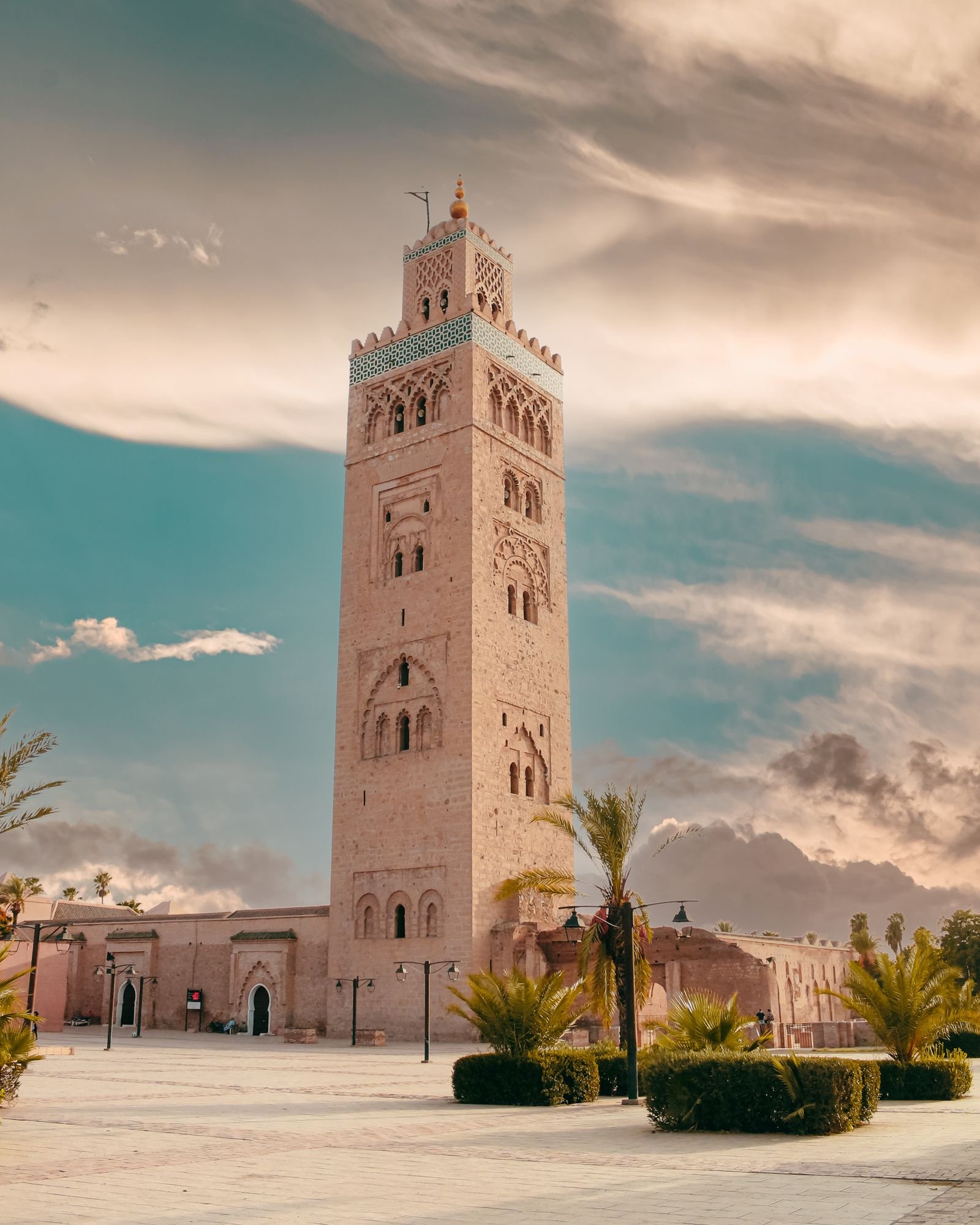
Hivernage is the strip of leafy avenues between Gueliz and the ramparts, and it's the answer for people who can't decide. It's mostly four- and five-star hotels with real swimming pools and gardens, plus the city's nightlife cluster and casino. The geography is its argument: 15 to 20 minutes on foot to the Koutoubia and Jemaa el-Fnaa, a similar walk into Gueliz for dinner, and it's the district closest to Menara airport — often under 15 minutes from the terminal.
You trade character for calm. Nobody falls in love with a Hivernage boulevard the way they do with a derb in Mouassine, but if you want a pool, a lift, a quiet night's sleep and the old city within walking distance, this is the most efficient base in Marrakech.
Palmeraie: pools, palms and the taxi tax
The Palmeraie is a historic palm grove north-east of the city, now dotted with walled resorts, boutique hotels and rental villas. It is genuinely lovely: big pools, birdsong, space for children to run, and the kind of silence the medina never offers. It is also 20 to 30 minutes from everything, and that's the part people underestimate. Every dinner, every museum, every wander through the souks is a taxi both ways — roughly 70 to 150 MAD each direction depending on your negotiating and the hour — and spontaneity quietly dies.
You stop popping out. Book the Palmeraie when the pool is the point: a villa with friends, a family who'll swim four days out of five, a wedding, a winter escape where you want warmth and not much else. Don't book it expecting to stroll into the medina.
What it actually costs
Rough shoulder-season bands, per night for two, are more useful than a star rating. In the medina, a simple but characterful riad runs about €25–45, a good mid-range riad with a nice courtyard and a decent breakfast €50–120, and the celebrated design riads climb well past €200. Gueliz apartments and modern hotels sit around €40–90 and give you the most space for the money.
Hivernage four- and five-stars generally start near €100 and run to €250 and beyond. Palmeraie resorts and villas span €80 to €300 depending on the pool and the season, and make sense per head when you're filling a villa. Prices spike hard over Christmas, New Year and Easter, and soften through the July–August furnace, when many riads quietly discount because the medina is brutal in the heat.
How your quarter changes your airport arrival
Menara airport is only about 6 km from the old city — 15 minutes on a clear run — but where you're staying decides how the last 300 metres go. A Gueliz, Hivernage or Palmeraie address is simple: the car pulls up at reception. A medina riad is not, because the derbs are too narrow for a vehicle. Your driver takes you to the nearest gate — Bab Doukkala, Bab Laksour or Bab Agnaou, depending on your quarter — and from there a porter with a cart walks your cases in.
Good riads arrange this the moment you send a flight number. That handoff is smooth when it's planned and genuinely miserable when it isn't: wheeling a suitcase down an unlit derb at midnight while two strangers offer to "help" is how a lot of Marrakech trips start badly. If you're landing late, travelling with children, or heading to a medina riad on night one, this is the arrival worth pre-booking rather than improvising at the rank.
Who should stay where
First time in Marrakech, three or four nights, here for the atmosphere: a riad in the Kasbah or Mouassine. Couple wanting romance and rooftops: a mid-range medina riad, ideally with a plunge pool. Family with young children: Hivernage or the Palmeraie, where there are lifts, real pools and no staircases to negotiate with a toddler and a pram. Returning visitor, or staying a week or more: Gueliz, every time — you'll cook, you'll find a local café, you'll stop being a tourist.
Budget travellers: the northern medina around Riad Laarous, or a Gueliz apartment. Here to swim, eat and do very little: the Palmeraie. Here for nightlife and a late dinner: Hivernage or Gueliz, since the medina largely shuts down and the riad door is a locked one at 1am.
The mistakes that spoil a Marrakech stay
Five come up again and again. Assuming a car will reach your riad door — it won't, and finding that out at midnight with three suitcases sets the tone. Booking "two minutes from Jemaa el-Fnaa" and discovering the square's drums run past 1am; ask for a room off the square, or stay two lanes back. Choosing the Palmeraie because the photos are gorgeous, without pricing in two taxis a day and the loss of every spontaneous evening.
Booking a July riad with no pool and weak air conditioning, when 45°C in a courtyard is a fact rather than a forecast. And picking a beautiful three-storey riad with a bad knee or a heavy case, because those tiled staircases are steep and there is no lift. None of these are hidden — they're just easier to fix before you book than after you arrive.
- Before you fly, ask your riad two questions: which Bab do we drive to, and will you send a porter?
- Few riads have a lift — pack for steep tiled stairs and an uneven derb.
- In July and August a plunge pool and genuine air conditioning aren't luxuries, they're the trip.
- "Two minutes from Jemaa el-Fnaa" often means drums until 1am; ask for a room away from the square.
- Most medina riads don't serve alcohol — Gueliz and Hivernage do.
- Save your riad's pin and the gate name offline; the derbs swallow GPS and phone signal.