
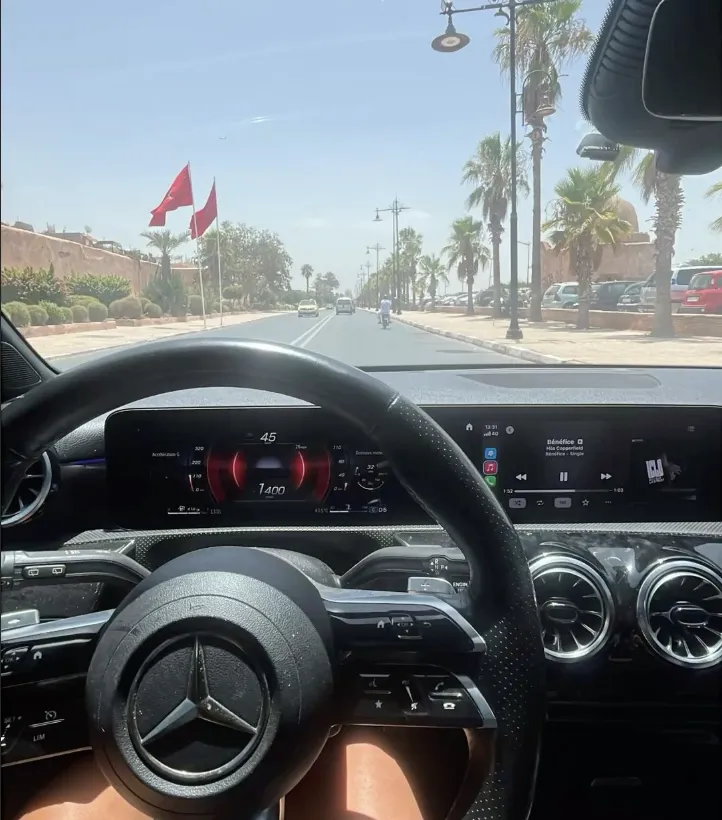
The ADM toll motorways, and how the péage works
Morocco's toll motorways — the autoroutes, run by ADM — are the part that surprises first-timers. They are wide, well-surfaced, properly signed and patrolled, the equal of any in southern Europe. The network links Tangier to Casablanca, Casablanca down to Marrakech and on to Agadir, with spurs to Rabat, Fes and Oujda. The system is simple. You pull a paper ticket from the machine as you join, then hand it back and pay at the péage barrier when you leave.
Pay in cash. Many booths still won't take a foreign card, and the staffed lanes move faster anyway. Keep a stash of coins and small notes in the door pocket so you're not digging through a wallet at the barrier. Casablanca to Marrakech costs around 80 MAD and takes about two and a half hours; Tangier–Casablanca and Marrakech–Agadir are comparable in feel. The toll is money well spent for the time, safety and sheer ease it buys you.
Gendarmerie checkpoints: have your papers ready
You will pass through gendarmerie checkpoints, especially on the approaches to towns and at junctions on the open road. For a tourist in a rental car they are almost always a non-event. Slow down, be ready to stop, and keep your documents within reach: licence, passport or a copy, and the rental agreement in the glovebox. An International Driving Permit alongside your licence smooths these encounters noticeably.
Officers recognise it instantly, and it saves any back-and-forth over an unfamiliar foreign card. A calm greeting in French or Arabic helps; "bonjour" and a smile go a long way. Most of the time the officer glances at the car, sees a visitor, and waves you straight through without asking for anything. If they do check papers, hand them over without fuss and you'll be moving again in under a minute. Treat the checkpoints as part of the landscape rather than something to dread.
Speed limits and radar: slow down before every village
Speed enforcement in Morocco is serious and constant. The limits are 120 km/h on the autoroute, 100 on the open road, and 40 to 60 km/h once you enter a built-up area. That last one is where visitors get caught. Radar speed traps, both fixed cameras and gendarmes with handheld units, are set up everywhere, and small towns put them right where the limit drops.
The fix is a habit. Lift off and brake well before the village sign, not as you reach it, because the limit applies from that board onward. Fines are typically settled on the spot in cash — a few hundred dirhams for a modest overspeed — and the officer will usually issue a receipt. Arguing rarely helps and politeness always does.
If you simply hold the posted limits and treat every cluster of buildings as a 40 zone until proven otherwise, you'll likely never be stopped for speed at all.
Parking, gardiens and the medina rule
In towns you'll meet the parking gardien — a man in a blue or yellow hi-vis vest who waves you into a space and watches the car. Pay him: 5 to 10 MAD for a daytime stay, up to 20 MAD overnight. It isn't an official fee so much as a small, sensible tip for an informal watchman, and a guarded car is a car that keeps its mirrors and hubcaps.
Hand it over on return, not arrival. The bigger rule is the medinas: you physically cannot drive into the old walled cities. Fes el-Bali, the Marrakech medina and Essaouira's ramparts are warrens of pedestrian lanes too tight for any car. You park at a gate or a public lot outside the walls and walk in. Riads will tell you the nearest car park and often send a porter with a cart for your bags. Plan your accommodation parking before you arrive rather than circling unfamiliar one-way lanes at dusk.
City traffic in Casablanca and Fes
City driving is the genuinely tiring part. Casablanca is a sprawling, fast, assertive city. Lanes are advisory, horns are punctuation, and a moment's hesitation invites three cars into the gap. Fes is tighter and older, with the Ville Nouvelle traffic funnelling toward a medina you can't enter anyway. Rabat and Tangier are more manageable. Agadir, rebuilt on a grid after the 1960 earthquake, is the easiest big city to drive of the lot.
The honest advice is to minimise time behind the wheel in the worst of it. Pick up or drop your rental at the edge of the city rather than the centre, use the car for getting out of town and exploring, and lean on petits taxis or the Casablanca and Rabat tramways for crossings within the city. There is no prize for braving rush hour in Casablanca with a guidebook on your lap. Let the car earn its keep on the open road instead.
Mountain passes: Tizi n'Tichka and Tizi n'Test
The high passes are a highlight and demand respect. The Tizi n'Tichka, the main route from Marrakech over the High Atlas to Ouarzazate, climbs to 2,260 metres on a relentless ribbon of hairpins. It has been widened and resurfaced in recent years and is in good shape. Even so, it is still two to three hours of full concentration: tight bends, big drops, slow trucks to overtake, and cloud that can drop you into fog without warning.
Drive it in daylight, leave early, and don't let a sunset deadline tempt you into the descent in the dark. The Tizi n'Test toward Taroudant is narrower, older and even more dramatic — spectacular, but only for confident drivers and never at night. Carry water, fuel up before you start, and check the brakes have bite. Pull into the laybys to let faster locals pass and to take in views that genuinely rank among the best drives anywhere.
Night driving is the real risk
If there is one piece of advice to take from this guide, it's this: don't drive rural roads after dark. Daytime driving in Morocco is fine. Night driving on unlit country roads is where the genuine danger lives. Once the sun is down you encounter vehicles running without lights, mopeds with no reflectors, donkey carts that materialise out of black, pedestrians walking on the carriageway, and livestock crossing where there's no fence.
Headlight glare from oncoming traffic is rarely dipped. The autoroutes are lit and far safer, but the two-lane roads between towns are not built for it. Build your itinerary around being parked by dusk, and if a drive runs long, stop in the nearest town for the night rather than push on. During Ramadan there's a specific extra. A rush of traffic hits in the half hour before iftar at sunset, as everyone hurries home to break the fast, so ease off and give it room. The rule is simple — arrive before dark.
Insurance, fuel and the practical paperwork
Before you collect the keys, understand the cover. Rental rates usually include basic third-party insurance and a collision damage waiver (CDW), but with an excess. That excess — the amount you're liable for after a bump — can run into thousands of dirhams, secured against your card as a deposit. Either accept the rental desk's excess-reduction upsell or buy standalone excess insurance before you travel, which is far cheaper.
Photograph every existing scratch at handover. Fuel is plentiful. Stations are frequent on main routes and always attended, so you tell the man how much you want, he pumps it, and a few dirhams' tip is the norm. Know whether your car takes diesel (gasoil) or petrol (essence) — most rentals are diesel — and expect to pay somewhere around 13–15 MAD per litre.
One more line to check: a one-way drop-off in a different city carries a fee, sometimes a steep one. Factor it in if your route doesn't loop back to where you started.
Roundabouts, signs and where a car truly pays off
Two last quirks. Roundabout priority can be genuinely ambiguous. In some places traffic already on the circle has right of way, in others entering traffic pushes in. The only safe approach is to go slowly, make eye contact, and assert your line without bullying. Signage is bilingual French and Arabic and mostly clear on main roads, but smaller turnings can be poorly marked.
Run Google Maps or Maps.me (which works offline) as a backup and trust it over a faded signpost. As for whether to drive at all: a car is the right call for the Atlas mountains, the Atlantic coast road, the Dadès and Todra gorges, and the long run to the Sahara at Merzouga or Zagora. These are trips where the journey is half the point and public transport is slow or nonexistent.
For a stay built around a single medina city, skip the car entirely and use airport transfers and taxis; the parking hassle and city traffic simply aren't worth it.
- Keep a stash of coins and small notes in the door pocket for the péage — many booths won't take a foreign card.
- Lift off and brake before the village sign, not at it — the lower limit applies from that board, and radar sits right behind it.
- Carry an International Driving Permit with your licence; it's recognised instantly at checkpoints.
- Pay the parking gardien on return: 5–10 MAD by day, up to 20 MAD overnight.
- Never aim a car at a medina — park at a gate and walk; riads will point you to the nearest lot.
- Drive the Tizi n'Tichka and other mountain passes in daylight only, and start early to beat the afternoon cloud.
- Be parked by dusk. If a drive overruns, stop in the next town rather than push on after dark.
- Buy standalone excess insurance before you travel — far cheaper than the rental desk's waiver, and it covers the deposit they hold.