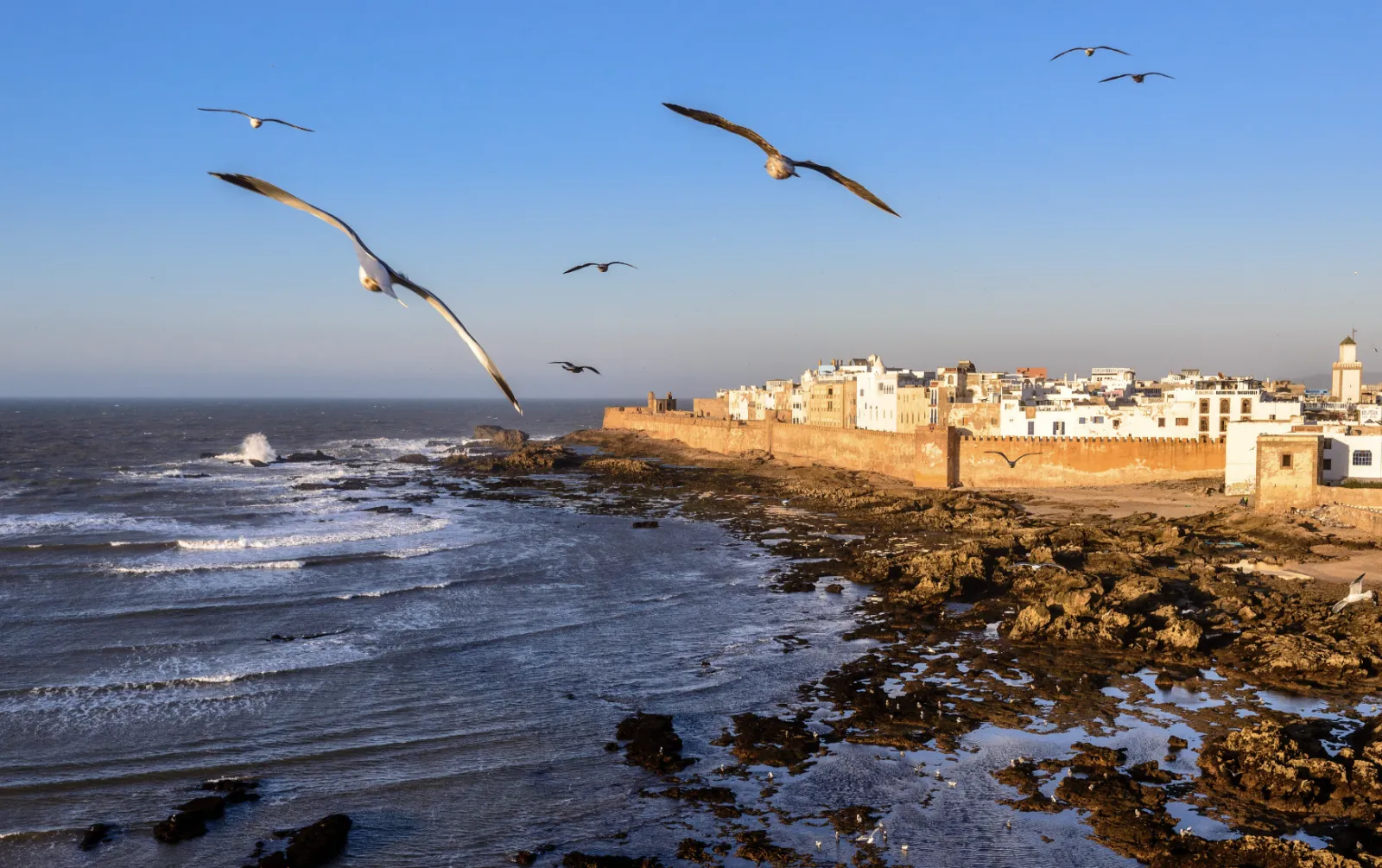
Three hours west of the terminal and the dry heat of Marrakech gives way to Atlantic wind — Essaouira keeps a different climate, a slower mood and a steady sea breeze that has made it a kitesurf town as much as a fishing port. The drive is genuinely half the experience rather than dead time between two points. You cross the argan plains, the one region on earth where goats really do clamber up the thorny trees to reach the fruit, and most private transfers fold in a stop at a women's argan cooperative where the kernels are still cracked and the oil ground by hand.
The road is the N8 west to Chichaoua, then the R207 cutting down toward the coast, flat and well-surfaced almost the whole way, with the only real bends arriving as you near the sea. By the time the white ramparts and the wheeling gulls come into view, you've already had a small road trip with a stop or two behind you.
It's a long haul by Marrakech-transfer standards, but a scenic and easy one — no mountain passes, no white-knuckle descents, just plains opening out and the temperature dropping a degree at a time as the ocean nears.
Compare your options
| Your options | Price from | Best for |
|---|---|---|
| Private transfer Recommended 3 h | €130 · 1400 MAD | Door-to-door with the argan and goat stops |
| Supratours / CTM coach 3 h | €9 · 100 MAD | Budget travellers happy with a fixed time |
| Shared grand taxi 2 h 55 | €9 · 100 MAD | Solo travellers counting every dirham |
How to get there
A private transfer from €130 is the comfortable, scenic choice, and its real advantage is that you can build the argan stops into the run — agree before booking whether the cooperative and the goat trees are part of the deal, because not every driver volunteers them and a bare point-to-point fare won't include the waiting time. The Supratours and CTM coaches cover the same route for 80–100 MAD and are reliable and air-conditioned, but they leave from Marrakech's bus stations rather than the airport, run a straight three-hour shot with no stops, and cap your luggage; Supratours, run by the rail operator, even drops you right by Essaouira's bus station near the medina.
Sharing a grand taxi from Bab Doukkala in Marrakech is the local budget move at roughly 80–100 MAD a seat, but you wait for it to fill, it's cramped six-up, and you can't tailor the route. Self-driving works fine on the N8 and R207 if you want freedom at the coast, though you'll sail past the genuine cooperative unless you know exactly where to pull in.
For most visitors arriving with bags and an appetite for the goat-and-argan detour, the transfer wins precisely because it turns three hours of transport into a half-day with stops on your own clock.
Arrival tips
Like Marrakech, Essaouira's medina is walled and largely car-free, so the driver stops at one of the gates — usually Bab Doukkala (yes, the same name as the Marrakech gate) or Bab Marrakech — or at the large car park beside Place Moulay Hassan. From there it's a flat, short, level walk into the old town, far gentler than the deep cobbled maze of Marrakech, and many riads are only a few minutes in.
Tell the driver your riad's nearest gate before you arrive so you're not circling the ramparts hunting for an entrance, and if you've booked a riad deep in the medina, ask whether they send a porter with a handcart for the last stretch. The wind that defines the town also means it can feel ten degrees cooler than Marrakech on the same afternoon, so have a layer reachable rather than buried in the boot.
Plan your arrival
- When booking a transfer, confirm whether a genuine women's argan cooperative and a goat-tree stop are included, with waiting time.
- At Menara, withdraw cash and check the driver has your riad's nearest gate — Bab Doukkala, Bab Marrakech or the Moulay Hassan car park.
- Keep a wind layer reachable; Essaouira often runs ten degrees cooler than Marrakech.
- If your riad is deep in the medina, ask in advance for a porter with a handcart at the gate.
- On arrival, head to the port grilled-fish stalls and agree the price per kilo before they cook.
Treating the cooperative stop as a guaranteed highlight. Many of the "argan cooperatives" lining this road are simply tourist-trap shops, and some drivers steer you to one for a commission rather than to a working women's co-op — confirm a genuine cooperative by name when you book, or you'll pay gift-shop prices for oil you could buy cheaper in the Essaouira medina.
Skip the medina restaurants on your first night and eat at the grilled-fish stalls between the port and Place Moulay Hassan — you pick your catch straight off the ice, they weigh it and grill it in front of you, and it costs a fraction of a sit-down place. Agree the price per kilo before they cook, as that's where the only haggling happens.
Good to know: A popular one-way transfer or day trip; agree whether stops are included when you book.