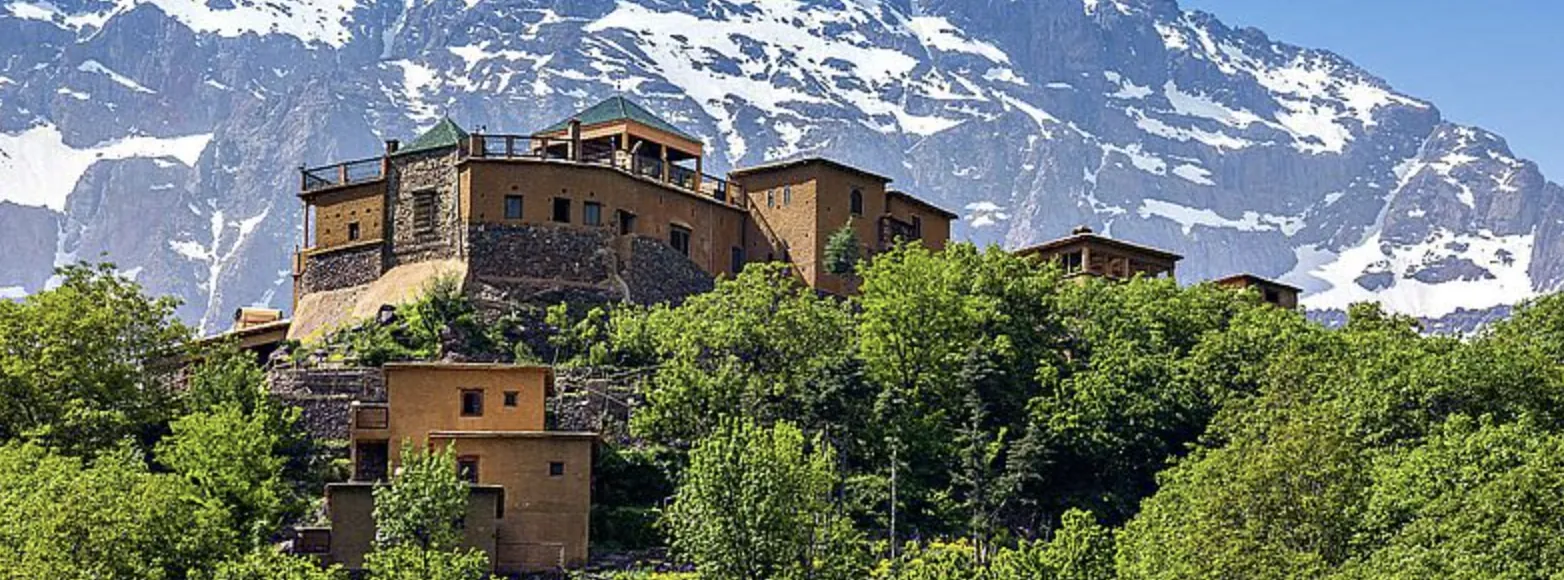
Imlil is where the road runs out and the mountains take over. Ninety minutes from the terminal, the route leaves the Haouz plain, climbs through the market town of Asni and up a steadily tightening valley until you reach the walnut-shaded village beneath Jebel Toubkal — at 4,167 metres, the highest peak in North Africa. The drive is short by distance but a real ascent in feel: you gain over a thousand metres, the last stretch above Asni narrows to a single tight ribbon of switchbacks hugging the slope, and at the village the tarmac simply stops in a square full of mules, café terraces and trekkers lacing boots.
From here it is your own legs and a muleteer's animal, nothing else. That is the thing to grasp before you book — this transfer doesn't end at a hotel door but at the precise point where the walking begins, which is exactly why trekkers like it. Arriving with a driver who knows every bend of the Asni road takes the white-knuckle guesswork out of a climb that a first-timer in a hire car can find genuinely unnerving, especially in the failing light of a late-afternoon arrival.
Compare your options
| Your options | Price from | Best for |
|---|---|---|
| Private transfer Recommended 1 h 30 | €55 · 590 MAD | Trekkers wanting door-to-trailhead with bags |
| Shared grand taxi (2 legs) 2 h | €6 · 60 MAD | Budget travellers with light packs |
| Self-drive hire car 1 h 35 | €30 · 320 MAD | Confident mountain drivers |
How to get there
A private transfer from €55 is the sensible choice for the winding climb via Asni, and a driver who runs it daily takes the narrow switchbacks above the town without drama, dropping you in the trailhead square ready to walk. The local budget route is two stages: a shared grand taxi from Marrakech's Bab er-Robb to Asni for around 25–30 MAD, then a change to a second shared taxi or a 4x4 up the final climb to Imlil for another 20–30 MAD per seat — cheap, but a faff with rucksacks, and the second leg waits to fill before it leaves.
Self-driving is fine as far as Asni on a good road, but the last narrow kilometres to Imlil are tight, steep and unforgiving for anyone not used to mountain hairpins, and parking in the village is limited. There's no direct public bus to Imlil itself. Most trekkers simply book the door-to-trailhead transfer, send their gîte the arrival time so a muleteer can meet them, and step out of the car already at the start line — the simplicity matters precisely because the trek ahead, not the drive, is meant to be the hard part of the day.
Arrival tips
The driver drops you in the village centre by the car park, among the row of cafés and the mule stands, and that square is literally the end of the drivable road. Gîtes and refuges higher on the slopes can't be reached by car at all, so they send a muleteer down to load your bags onto an animal and carry them up the final stone paths — arrange that with your lodge in advance, with your arrival time, rather than hoping to sort it on the spot.
Change into proper footwear before you even leave the car, because the village lanes are rough, stony and often slick with meltwater underfoot. And dress for altitude: at 1,800 metres Imlil runs far cooler than the city, and the moment the sun drops behind the ridge in late afternoon the temperature falls fast.
Plan your arrival
- Before you fly, tell your gîte your arrival time and ask them to send a muleteer to meet you in Imlil's square if your lodge is above the village.
- At Menara, withdraw cash for tips and the muleteer, and pack a warm layer where you can reach it.
- Confirm with your driver that the run goes via Asni and ends in the village car park, not part-way up.
- Change into proper trekking footwear before leaving the car — the village lanes are rough and often wet.
- At the square, hand your main bag to the muleteer and follow on foot up the stone paths to your lodge.
Expecting the car to carry on past the village up to your lodge. The drivable road ends in Imlil's central square — every gîte and refuge higher up the slope is reached on foot or by mule only, so don't book assuming a door drop at a hillside lodge, and do arrange a muleteer in advance if your bed is above the village.
Pack a warm layer in your day bag even in midsummer. Imlil sits at 1,800 metres and the air is sharply cooler than Marrakech the moment you arrive, dropping further once the sun leaves the valley in the late afternoon. Plenty of people step out of the car in shorts and a T-shirt and regret it within the hour.
Good to know: The final climb is narrow; a transfer drops you right at the village trailhead.