
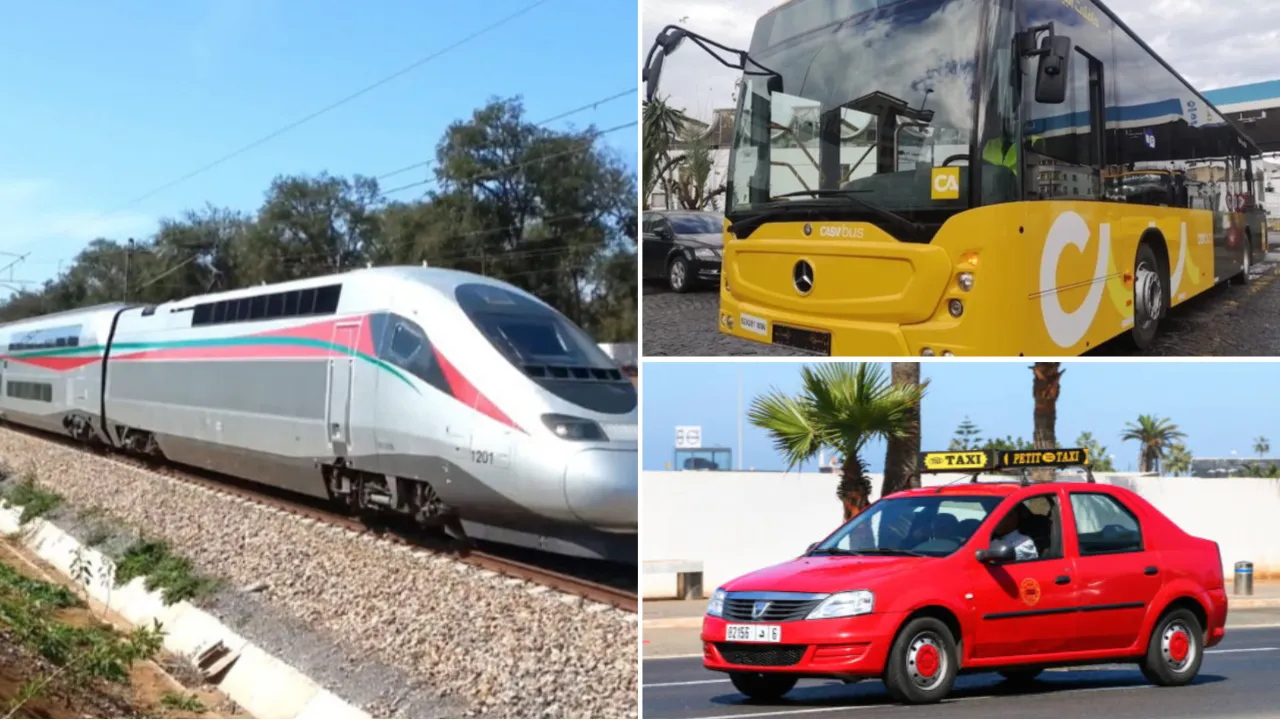
ONCF: the railway that holds it all together
ONCF, the national railway, is the part of Moroccan transport that genuinely impresses visitors. Trains are clean, run to a printed timetable, and cost a fraction of European fares. Casablanca to Rabat is under an hour and around 40 MAD. Casablanca to Marrakech is about three hours for roughly 100–140 MAD depending on class. The network is a Y-shape. A busy trunk runs down the Atlantic coast from Tangier through Kenitra, Rabat and Casablanca; one arm bends inland to Fes and Meknes; the other drops south to Marrakech.
Departures on the main corridors run roughly hourly through the day, so you rarely plan your life around a single train. What ONCF does not do is reach the coast resorts or the mountains. No line serves Essaouira, Chefchaouen, Agadir or the desert — which is exactly where the coaches earn their place.
Al Boraq: Africa's first high-speed line
Al Boraq opened in 2018 as the first high-speed rail on the continent, and it reshaped the north. The train covers Tangier to Casablanca in about 2h10, calling at Kenitra and Rabat. The old line took nearly five hours. Second-class fares start around 150 MAD if you book ahead, with first class a modest step up. Trains hit 320 km/h on the dedicated section between Tangier and Kenitra, then run on upgraded conventional track into Rabat and Casa-Voyageurs.
For anyone landing in Tangier or doing the Rabat–Tangier run, it turns what was a half-day slog into a morning errand. Buy these tickets early. Al Boraq seats are fully reserved, and the cheapest fares sell out first on weekends and holiday periods.
Standard trains: Casablanca, Rabat, Fes, Meknes, Marrakech
Outside the high-speed corridor, ONCF's conventional trains (branded Al Atlas) do the daily heavy lifting. They are the workhorses most travellers actually ride. Casablanca and Rabat are joined by a near-constant shuttle. Fes and Meknes sit on the inland arm a few hours from the coast, and Marrakech anchors the southern end. A typical run like Rabat to Fes takes about three hours and costs in the region of 100–130 MAD.
Carriages are either compartment-style (six or eight seats facing each other) or open-plan, both with luggage racks. Trains can fill on Friday afternoons, Sunday evenings and the start of school holidays. So even if you usually wing it, those are the days to reserve. Check live times on the ONCF app rather than trusting a printout — schedules shift seasonally.
First class vs second class: which to buy
The two classes are closer than the names suggest, and the choice comes down to one thing: a guaranteed seat. Second class is comfortable and perfectly fine. But on conventional trains it can be sold beyond the number of seats, so on a packed Friday you may stand or perch on your bag. First class costs only a handful of dirhams more — often 30 to 50 MAD on a long run.
Every ticket maps to a specific reserved seat in a quieter, less crowded carriage. On Al Boraq both classes are fully reserved, so there the upgrade is purely about legroom and calm. Here's the rule of thumb. On a quiet midweek hop, second class is all you need. On any busy day, with luggage, or for a journey over two hours, pay the small premium for first and travel sure of a seat.
Booking: the ONCF app and website
ONCF sells tickets three ways — at station counters, from machines, and through the ONCF Voyages app and website. For a visitor the app is easily the most painless. It shows live departures, lets you pick a class and seat, and takes foreign cards. It then stores the ticket as a QR code you flash at the platform gate, so you skip the counter queue entirely.
Book conventional-train tickets the day before for busy periods, and they're often a touch cheaper than at the window. Al Boraq should be booked as early as you can, because the lowest fares are capacity-controlled and climb as the train fills. If the app rejects your card (it happens), the station counters take cash and most foreign cards. Staff at the big stations usually speak enough French or English to sort you out.
The Casablanca airport train — and why it's the exception
Casablanca's Mohammed V airport has something almost no other Moroccan airport does: a train station directly beneath the terminal. The airport line runs to Casa-Voyageurs and on to Casa-Port and the city centre for 60 MAD in 2nd class (80 MAD in 1st class), roughly every hour. It takes about 40 minutes to Casa-Voyageurs. From there you can connect onward to Rabat, Marrakech or the Al Boraq north without ever touching a taxi.
It is the single best-integrated airport transfer in the country. The catch is that it is the exception. Marrakech, Fes, Tangier and Agadir airports have no rail link at all, so arriving there means a petit taxi, a city bus, or a pre-booked transfer for that first leg. Treat the Casa airport train as a happy bonus, not the national norm.
CTM and Supratours: where the coaches take over
For everywhere the rails miss, two coach companies are the reliable choice: CTM, the long-established national operator, and Supratours, run by ONCF to feed its train network. Both use modern air-conditioned coaches with assigned seats and fixed departure times. There's a small per-bag fee for the hold, usually 5–10 MAD, paid to the handler who tags your luggage. They are a different world from the unbranded local buses that crawl from town to town stopping everywhere.
Book CTM or Supratours and you get a printed seat, a timetable that's roughly kept, and a hold for your bags. Supratours often departs from beside the train station and sells through ONCF, which makes train-plus-coach trips easy to chain. CTM runs from its own terminals. For any of the off-rail destinations below, these are the buses to look for.
Real coach fares: Essaouira, Chefchaouen and the south
Concrete numbers help you spot a fair price. Marrakech to Essaouira on Supratours or CTM is about 80–100 MAD and runs roughly three hours, with several departures a day. It's the standard way to reach the coast, since no train goes there. Fes to Chefchaouen is around 90–120 MAD and takes four hours or so over the Rif foothills, again coach-only.
Marrakech down to the desert gateways — Ouarzazate, and onward toward Merzouga and the Erg Chebbi dunes — is a longer Supratours haul. It's often booked as part of a tour, but available as scheduled coaches too. The deeper south and the dunes are firmly coach (or organised 4x4) territory; rails stop well short. Book these a day ahead online during high season and around Eid. That's when seats vanish and you don't want to be left waiting for the next departure.
Grands taxis collectifs: filling the gaps
Between towns too close or too minor for a coach, the grand taxi collectif takes over. These are the old cream Mercedes sedans, and increasingly Dacia Logans, that work from fixed ranks organised by destination. You buy one of six shared seats (two up front, four behind), pay a fixed per-seat price that locals pay too, and the car leaves the moment it fills.
Marrakech to Essaouira runs about 70–90 MAD a seat; shorter hops like Tangier to Tetouan are 35–45 MAD. There's no meter and no haggling on the standard shared rate — just confirm the per-seat price before you climb in. The trade-off is comfort. Six adults in a sedan is snug, and you wait for the car to fill, which can be five minutes or the better part of an hour on a quiet route. For a short link the coaches skip, nothing beats it for frequency and price.
City trams and local buses
Inside the big cities, two tram networks make crossing town effortless. Casablanca and the Rabat-Salé conurbation both run modern light-rail lines — clean and frequent. The flat fare is roughly 6–8 MAD however far you ride, paid by a rechargeable card or at platform machines. They're the smart way to cover long, traffic-clogged crossings that would cost far more by taxi.
City buses are a different story. Alsa runs the networks in Marrakech and Rabat, and they're genuinely cheap (a few dirhams), but slow, crowded and awkward with luggage. The one bus route worth knowing is Marrakech's number 19, a dedicated airport shuttle. It loops between the airport, Jemaa el-Fnaa and Gueliz for around 30 MAD return — useful if you're travelling light, less so with a suitcase and a tired family in tow.
How the pieces fit — and journey times
Picture it as a system: the train is the spine, the coaches are the branches, the grands taxis are the twigs. A classic itinerary chains them without friction. Take Al Boraq from Tangier to Casablanca in about two hours, a conventional train on to Marrakech in around three, then a Supratours coach out to Essaouira in three more. Here are rough timings to plan around.
Casablanca–Marrakech is about 3h by train, Casablanca–Fes roughly 3h15, Casablanca–Tangier about 2h on Al Boraq. The recurring weak link, every time, is the airport last mile, because stations almost never sit at the terminal. Build that hop in as a separate step — a transfer or taxi — and the rest of the country opens up cheaply and reliably. One scheduling note: around national holidays and Eid, trains and coaches both fill days ahead, so book early or travel a day either side of the rush.
- Download the ONCF Voyages app before you arrive — it takes foreign cards and stores tickets as QR codes.
- Book Al Boraq early; the cheapest second-class fares are capacity-controlled and climb as the train fills.
- First class is usually 30–50 MAD more on a long run and guarantees a reserved seat — buy it on busy days.
- For off-rail towns (Essaouira, Chefchaouen), look specifically for CTM or Supratours, not unbranded buses.
- Confirm the per-seat price of a grand taxi before you get in — the shared rate is fixed, so there's no haggling.
- Only Casablanca airport has a train under it; budget a taxi or transfer for the last mile at every other airport.
- Carry small notes — coach luggage handlers, tram machines and taxi drivers all prefer 20s and 50s.
- Around Eid and school holidays, reserve trains and coaches days ahead; seats genuinely run out.