
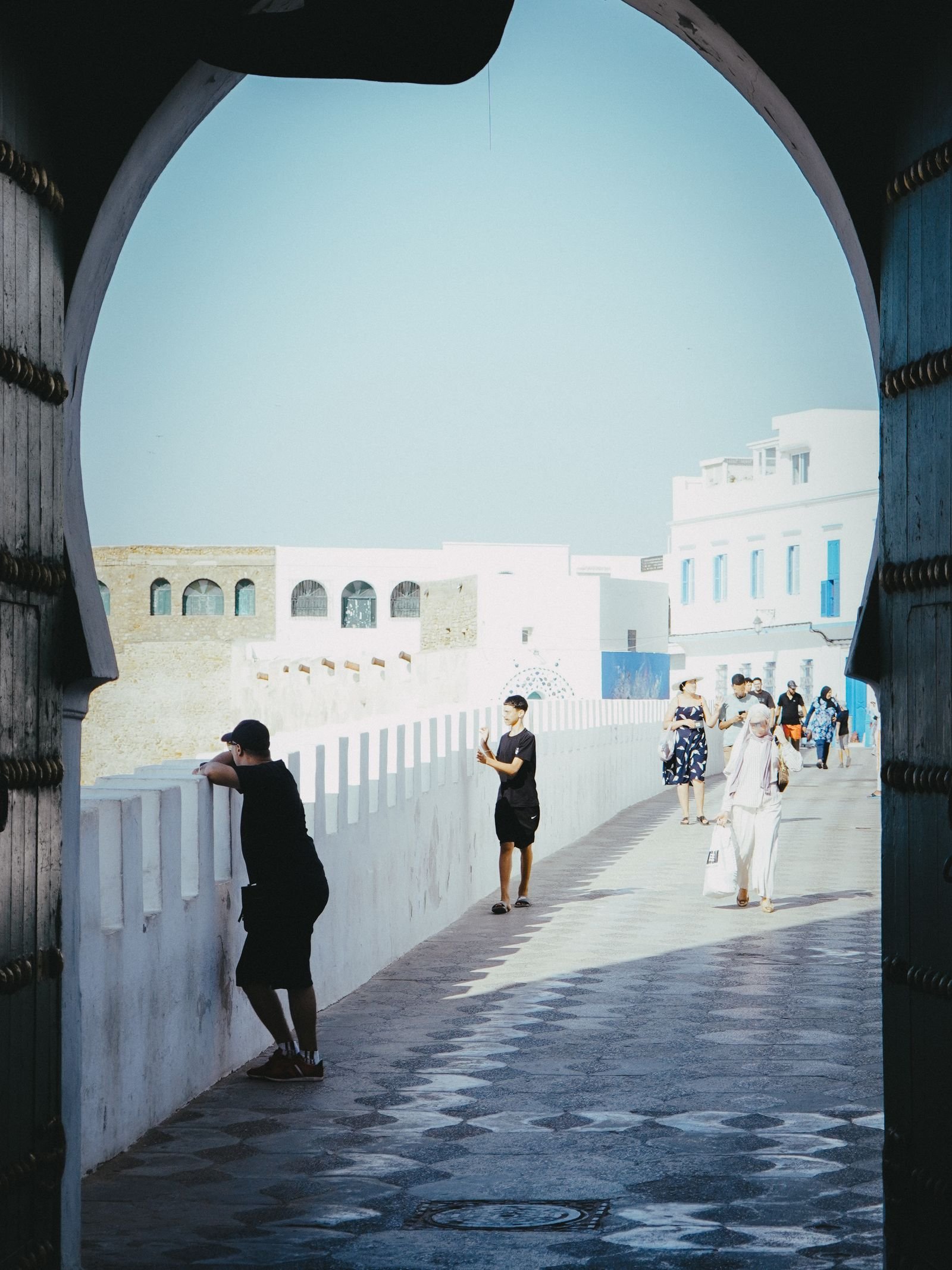
A grid, a wall and an ocean
Essaouira — Mogador, until independence — is a fortified Atlantic port about three hours west of Marrakech, and it's laid out unlike anywhere else in Morocco. In the 1760s the sultan hired a French engineer to design it, and he did what a European of his era would: straight streets on a grid, wide enough for two carts, wrapped in ramparts with bastions facing the sea.
The upshot is a medina you can read in an afternoon. Place Moulay Hassan is the hinge — cafés on one side, the fishing port on the other. The Skala de la Ville runs along the sea wall with its old brass cannons. And south of the walls, a long sandy bay curves away toward the dunes. Whitewashed walls, blue shutters, gulls, salt in the air: it reads more like an Atlantic island town than the Morocco of the interior.
The wind is not a detail — it's the climate
Essaouira's nickname is the windy city of Africa, and it is not marketing. The alizés — the Atlantic trade winds — blow hard here, strongest from roughly April to September, and they are the entire reason the kitesurf and windsurf scene exists. This cuts both ways, and it's the single most misjudged thing about the town. If you came to ride, this is one of the most reliable spots on the continent and you'll be delighted.
If you came to lie on a beach with a book, you will be sandblasted from about eleven in the morning and you'll retreat behind the walls by lunch. The medina itself is largely sheltered — that's what the ramparts do — so the town stays pleasant while the beach is a wind tunnel. Judge every accommodation decision here through that lens.
The medina: white, blue and easy
Almost everyone should stay inside the walls. The grid means short, flat, legible walks — no stepped lanes like Chefchaouen, no thousand-alley maze like Fes, and while the main arteries are pedestrian-dominated you're never more than a few minutes from a gate where a car can reach you. Riads and dars here are converted merchants' houses, whitewashed with the blue shutters, and the light off the ocean does something to the interiors that the ochre cities can't match.
The trade-offs are specific to Essaouira rather than generic medina ones. Sound carries in the streets, which are busier and later than you'd guess. Sea damp gets into old houses — a cheap room in winter can feel clammy. And then there are the gulls: if your riad sells you a roof terrace, it is also selling you a colony of herring gulls that start up well before sunrise and treat the parapet as theirs.
Inside the medina: which quarter
Around Place Moulay Hassan and the port end you get the liveliest version — cafés, the fish grills, the boats, and the constant traffic of everyone heading to the harbour. Great for atmosphere, noisiest for sleep. The Kasbah quarter, just behind the Skala and the sea wall, is the sweet spot for most: a couple of minutes from the square, quieter lanes, and some of the loveliest converted houses in town.
The northern medina and the Mellah — the old Jewish quarter — are rougher around the edges and mid-restoration, which makes them cheaper, calmer and more real; you're a five-to-ten-minute walk from the action and you'll get more house for the money. Near Bab Doukkala and Bab Marrakech, at the medina's landward gates, you're least atmospheric and most practical: this is where a car and a taxi actually reach you.
The beachfront and Avenue Mohammed V
Along the bay south of the ramparts sit the modern hotels — sea views, lifts, pools, car access at the door, and a ten-to-twenty-minute walk into the medina along the front. There's a real case for it: if you want a balcony over the Atlantic, a proper pool, and no staircase, this is where you get it, and you're still close enough to walk in for dinner.
The case against is that the strip is fairly characterless compared with what's behind the walls, and it takes the wind full in the face — that same balcony is often too breezy to sit on by afternoon. It's a good pick for families, for anyone with mobility issues, and for a longer stay where you want a base with a pool rather than a beautiful box.
Diabat and the dunes: resort territory
Five kilometres or so south, past the river mouth toward Diabat and the dune belt, are the big resorts, golf and villa developments. They're calm, spacious and well appointed, with the beach at the bottom of the garden and nobody around. They're also a taxi ride from everything, and Essaouira's entire charm is a walkable medina you can wander out into at nine at night for grilled fish.
Book out here if the resort itself is the holiday — golf, kids, a big pool, a week of doing very little — and specifically not if you want the town. It's the same trade as Marrakech's Palmeraie: lovely, and quietly disconnected from the reason you came.
What it actually costs
Essaouira sits below Marrakech and roughly level with Fes. Shoulder-season, per night for two: a simple medina guesthouse runs about €25–45; a good dar or riad with a terrace, blue shutters and a serious breakfast is around €50–100; the seafront hotels along Avenue Mohammed V land roughly €60–120 depending on the view and the pool; the Diabat resorts start near €100 and climb a long way.
Two things move these numbers hard. The Gnaoua World Music Festival in June fills every bed in town and multiplies rates — book months out or pick different dates. And July and August are peak, because half of Marrakech comes here to escape the heat, which is exactly when Essaouira is at its most pleasant and its most booked.
Getting here: the airport question
Essaouira has a small airport of its own, Mogador, about 15 km south — but it runs a thin, seasonal schedule of European flights, so most travellers never touch it. In practice you arrive overland from Marrakech, roughly 190 km and about three hours, or from Agadir, roughly 175 km and about two and a half. The Marrakech run is the classic: a straight, easy road across the scrub with argan trees and a co-operative stop on the way, which is why it's also the most popular day trip in the country.
Coming by CTM or Supratours coach is cheap and civilised; a shared grand taxi is cheaper and less so; a private transfer costs more and gets you door-to-gate with your luggage and no waiting. Whichever you pick, the medina's landward gates — Bab Doukkala and Bab Marrakech — are where vehicles set you down.
Who should stay where
First visit, here for the town: the Kasbah quarter inside the medina — quiet lanes, two minutes from the square, the best houses. Kitesurfers and windsurfers: the beachfront or the southern end of the bay, close to the schools and the launch. Photographers and slow travellers: anywhere in the medina, ideally with a terrace, and accept the gulls. Families: the seafront hotels, for the pool, the lift and the car at the door.
Light sleepers: the Mellah or northern medina, and not Place Moulay Hassan. Budget: the northern medina gives you the most house per euro. Resort holiday, golf, doing nothing for a week: Diabat and the dunes — just know you're choosing a resort over a town.
The mistakes that spoil an Essaouira stay
Booking Essaouira as a beach holiday. It isn't one — it's a windsports town with a beach attached, and the alizés will decide your afternoons from April onward. Taking the rooftop room without thinking about the gulls, then discovering they're a pre-dawn alarm you can't switch off. Coming in June without checking the Gnaoua dates, and finding the town at four times the price and shoulder to shoulder.
Booking a cheap old medina house in winter and learning what Atlantic damp does to a stone room with no heating. And treating it as a Marrakech day trip: three hours each way for four hours in town means you'll see the port, eat a fish, and miss the thing everyone actually falls for — the medina at dusk, when the day-trip coaches have gone and the light goes gold on white walls.
- The medina is a grid — you can't get lost. Relax and pick the quarter on noise, not navigation.
- Wind runs roughly April–September. Superb for kitesurfing, hopeless for sunbathing.
- A roof terrace means gulls before sunrise. Ask for an interior room if you sleep lightly.
- Essaouira is cool year-round — bring a jacket for the evenings even in August.
- Check the Gnaoua festival dates in June before you book anything.
- Cars reach Bab Doukkala and Bab Marrakech; the walk in from there is short and flat.