
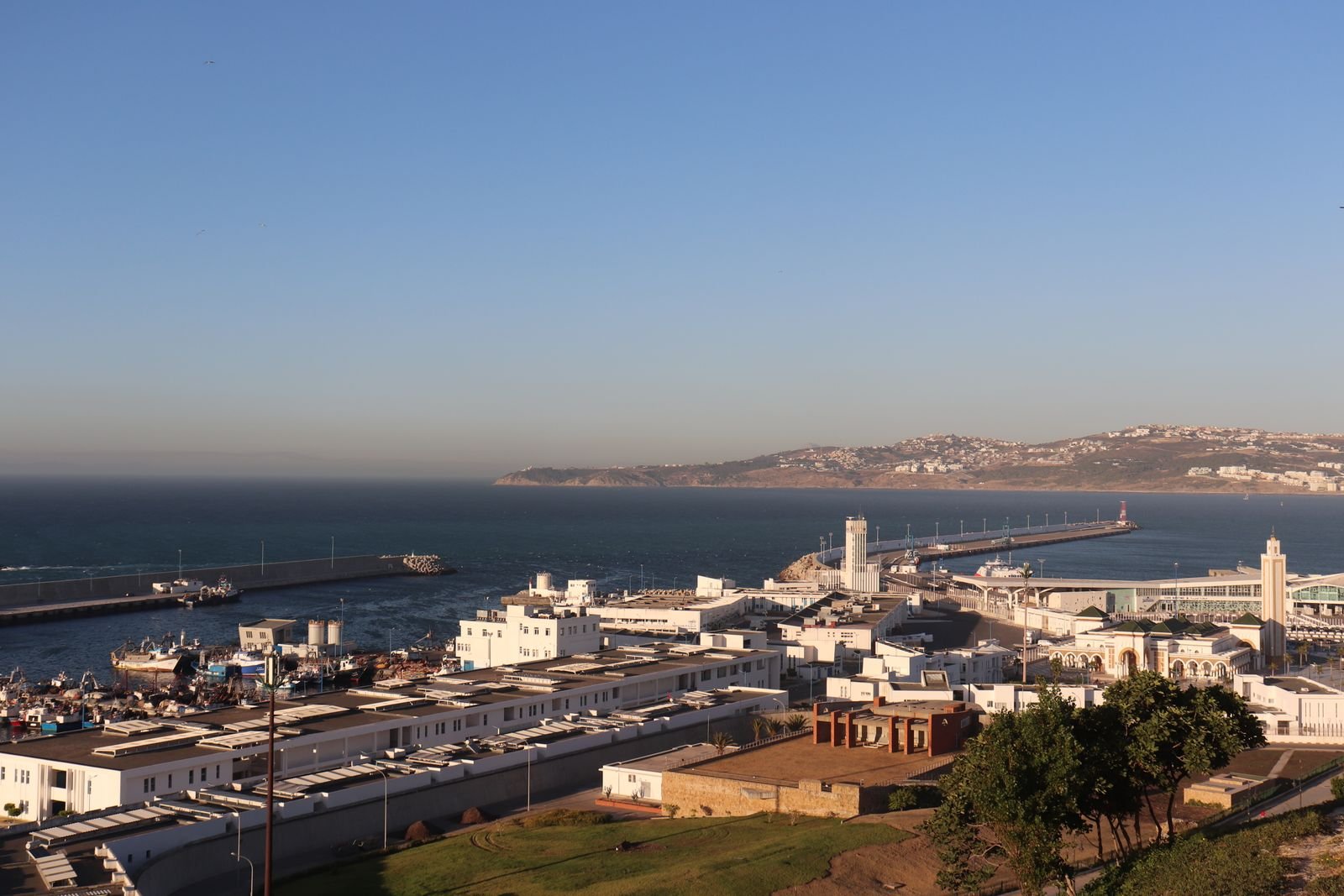
A city on a hill between two seas
Tangier sits where the Atlantic meets the Mediterranean, fourteen kilometres from Spain — close enough that on a clear day you stand on the ramparts and look at another continent. The city is stacked on a hillside above its port. At the top is the Kasbah, the old citadel. Below it spreads the medina, walled and tumbling downhill. The Grand Socco — officially Place du 9 Avril 1947 — is the hinge where the medina meets the modern city, and above and west of that lies the Ville Nouvelle, the boulevards the European powers built.
West again is Marshan, high and residential above the cliffs; east along the bay runs the corniche toward the Malabata hotels. Five distinct places, all within a couple of kilometres, and they offer genuinely different stays.
The ghost that makes Tangier different
From 1923 to 1956 Tangier was an International Zone, run jointly by a committee of foreign powers and effectively by nobody — which made it a haven for spies, smugglers, tax exiles, and a generation of writers who came for the cheap rent and the absence of rules. Paul Bowles stayed for fifty years. Burroughs wrote much of Naked Lunch here.
Kerouac, Ginsberg, Capote, Matisse, and later the Rolling Stones all passed through. That history is Tangier's real differentiator — no other Moroccan city has it — and it's still legible on the ground: the Petit Socco cafés in the medina where the deals were done, Café Hafa on the Marshan cliffs where Bowles drank mint tea from 1921-vintage terraces, the Gran Café de Paris on Place de France.
If you're choosing between Moroccan cities and this appeals, it should push Tangier up your list; if it means nothing to you, Tangier has less to offer than Fes or Marrakech.
The Kasbah: the address to want
The Kasbah is the walled citadel at the summit of the medina, and it is the best place to sleep in Tangier. It's quieter than the medina below — residential rather than commercial, with almost no through traffic — and it holds the grandest houses, which is why the artists, writers and expat buyers colonised it. The dars and small riads up here are often beautiful, and the thing you're really paying for is the view: terraces looking north across the Strait of Gibraltar, with the Spanish coast on the horizon and the container ships sliding past.
The Kasbah Museum sits in the old sultan's palace on the square. The catch is the same as any medina: cars stop at the gates, and you're walking up. It's a shortish climb by Moroccan standards — nothing like Chefchaouen — but it is a climb.
The medina and the Grand Socco
Tangier's medina is a relief after Fes. It's small, it's built on a slope so you always know which way is out, and the lanes are wider and better signed than the imperial cities'. The Petit Socco is its old louche heart — a tiny square of cafés that was the centre of the International Zone's less legal business, and is now simply a good place to sit.
The Grand Socco, just outside the walls, is the great hinge of the city: markets, the Cinema Rif, taxis, and the point where a car can actually reach you. Staying in the medina proper puts you in the middle of things and costs less than the Kasbah, at the price of more noise and more of the low-level hustle that Tangier is still shaking off. It's improved enormously, but the medina lanes are where you'll still meet the occasional unsolicited guide.
The Ville Nouvelle: where the city works
Up and west of the Grand Socco, the Ville Nouvelle is Tangier's functioning modern centre — Boulevard Pasteur, Place de France, the Terrasse des Paresseux with its view over the port, and the Gran Café de Paris still doing brisk trade off its literary reputation and a cameo in the Bourne films. This is where you get real restaurants, bars that serve without fuss, banks, pharmacies, and hotels with lifts and reliable heating.
It's a ten-minute walk down to the medina gates. Choose it if you want the city rather than the picture of it: it's the practical, comfortable, unromantic option, and it's a considerably better proposition than Fes's Ville Nouvelle because Tangier's actually has life in it.
Marshan and the cliffs
West of the Kasbah, Marshan is the leafy residential plateau above the sea — quiet streets, consulates, old villas, the Phoenician tombs cut into the cliff, and Café Hafa, which has been serving mint tea on stepped terraces over the water since 1921 and is the single best hour you can spend in this city at sunset. Staying up here gives you calm, air, and a genuinely local neighbourhood, with the Kasbah a ten-minute walk away.
There's less on your doorstep at night and you're above the tourist circuit rather than in it. It's the pick for repeat visitors, longer stays, and anyone who wants Tangier as a place to live in for a week rather than a sight to tick off.
Malabata, the corniche and the beach question
East along the bay, the corniche runs out toward Malabata, where the larger modern hotels sit — sea views, pools, lifts, car access, and a promenade that's been substantially rebuilt in recent years. It's comfortable and it's convenient for families. But be clear about the beach: Tangier's city beach is urban, it faces a working port and a busy bay, and it's fine for a walk rather than a week of sunbathing.
If a beach holiday is the goal, Morocco has better answers on the Atlantic coast. Take Malabata for the pool, the space and the sea-facing balcony, and treat the city — a fifteen-minute taxi away — as the actual attraction.
What it actually costs
Tangier is mid-priced by Moroccan standards and rising as the city gentrifies. Shoulder-season, per night for two: a simple medina guesthouse runs about €25–45; a good dar in the medina €45–85; a Kasbah riad with a terrace and a Strait view, roughly €70–150, and the best of them go well beyond that; Ville Nouvelle hotels sit around €40–90 and buy you a lift and a central location; the Malabata seafront hotels are about €60–130 depending on the pool and the view.
Summer is peak — this is where Moroccans and the diaspora come in August, and the city is genuinely full — while winter is cheap, wet and windy. Spring and autumn are the sweet spot.
Getting there, and getting onward
Tangier Ibn Battouta is about 15 km from the centre — roughly 20 minutes, one of the shortest airport runs in the country. The official taxi is around 150 MAD by day and 200 MAD at night, and a pre-booked transfer starts near €18. If you're heading to the medina or the Kasbah, the same rule as every walled Moroccan city applies: the car stops at a gate, most often the Grand Socco or the Kasbah gates, and you walk the last stretch — so ask your riad which one and expect a short climb.
Tangier is also Morocco's great connecting city, and that shapes a lot of stays here: the Al Boraq high-speed train reaches Casablanca in a bit over two hours, ferries cross to Spain, and Chefchaouen is 117 km and about two hours by road, with Tetouan at 70 km and Asilah a mere 45 km down the coast.
Who should stay where
First visit, two nights, want the view and the atmosphere: a dar in the Kasbah. Budget, or want to be in the thick of it: the medina near the Petit Socco. Practical, comfortable, here to eat and drink well: the Ville Nouvelle around Boulevard Pasteur. Repeat visitors and long stays: Marshan, with Café Hafa as your local. Families, or anyone wanting a pool and a lift: Malabata and the corniche.
Catching an early ferry or the Al Boraq to Casablanca: the Ville Nouvelle or near the port, and don't book the Kasbah for a 6am departure with luggage. And if you're only here to change transport, be honest and book near your departure point — but consider giving it two nights instead, because the Tangier people write off is the Tangier they didn't stay in.
The mistakes that spoil a Tangier stay
Treating it as a four-hour ferry stopover, seeing the port and the touts, and concluding the city is a dump — that judgement is fifteen years out of date and it's the most common mistake made here. Booking the Kasbah for an early departure and dragging a suitcase down through the medina at dawn to reach a taxi. Coming for a beach holiday: the city beach faces a working port, and the Atlantic coast does this far better.
Expecting Fes-grade heritage — Tangier's draw is atmosphere and a literary past, not monumental architecture, and if that's not your thing the city can feel thin. And underestimating winter: the Levante wind and the Atlantic rain make January here grey, blowy and cold, in a way that surprises people who think of Morocco as a desert country.
- The Kasbah has the Strait views — on a clear day you can see Spain from a terrace.
- Café Hafa in Marshan, at sunset, mint tea, cliff terraces since 1921. Don't skip it.
- Cars reach the Grand Socco and the Kasbah gates; ask your riad which, and expect a short climb.
- Don't book the Kasbah if you have a dawn ferry or train — the medina walk with luggage is a bad start.
- Tangier's beach is urban and faces a working port. Come for the city, not the sand.
- Winter is wet and windy here, not desert-dry. Check the heating and pack a coat.