
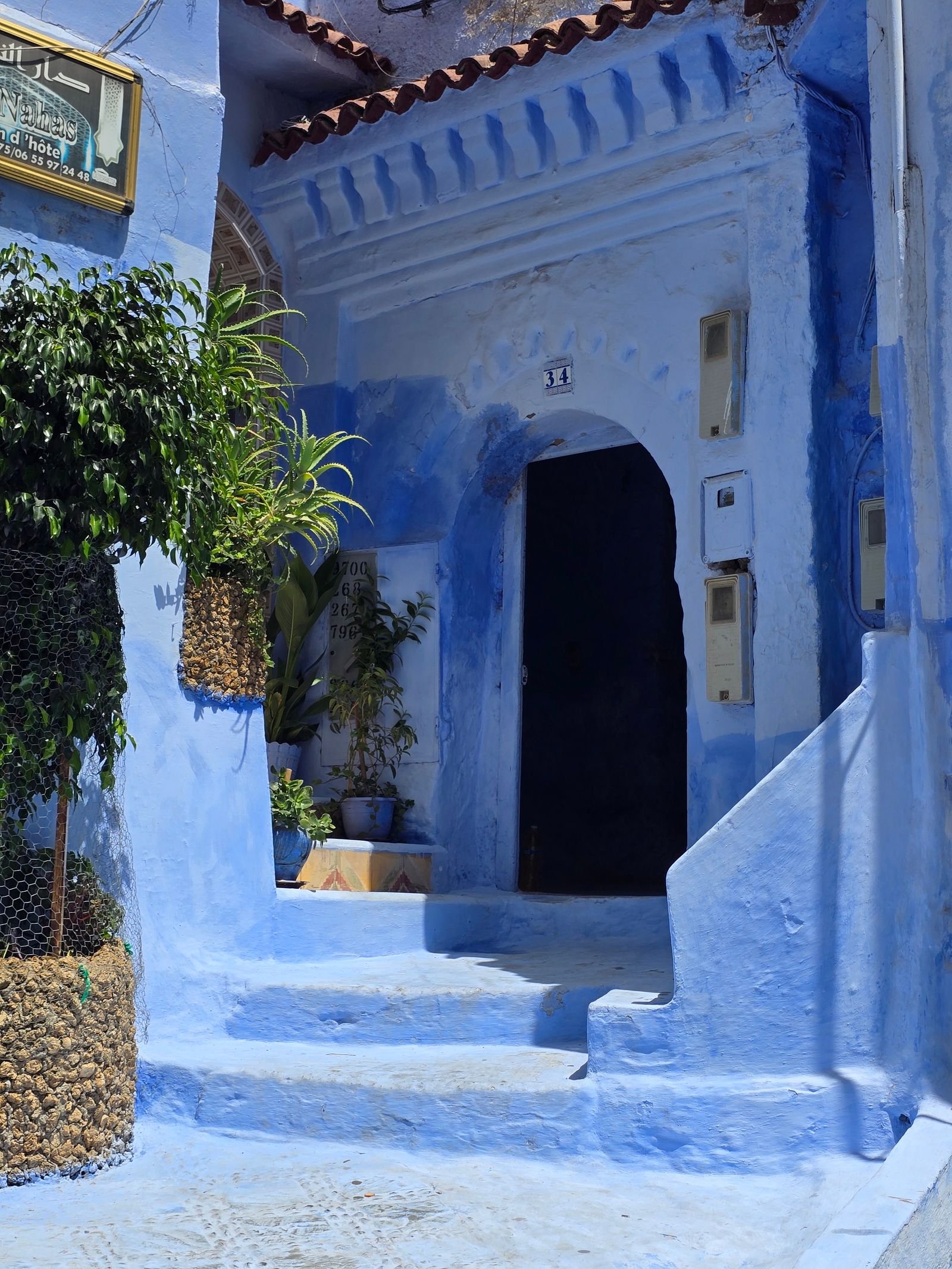
A blue town built on a slope
Chefchaouen sits in the Rif mountains in Morocco's north, founded in 1471 as a fortress and painted, over the last century, the cobalt and powder blue that now draws everyone here. The town divides simply. There's the medina — small, walled, blue, and climbing steeply up the mountainside — and there's the modern town below and around it, strung along the ring road.
At the medina's low western edge is Plaza Mohammed V and the main gate, Bab el-Ain. At its high eastern edge is Ras el-Maa, the spring where the water comes tumbling out of the rock and the women still wash clothes. Between those two points is a twenty-minute walk, and perhaps eighty metres of climb. That climb is the single fact that should shape your booking.
The medina: small, blue, and steeper than the photos admit
After Fes, Chefchaouen's medina feels like a toy. There are a few dozen lanes, not a few thousand; you orient by the slope — down is out, up is Ras el-Maa — and within an hour you stop needing a map. Outa el-Hammam, the main square, sits roughly in the middle with the kasbah and the Grand Mosque on it, and the cafés spill out under the walls.
What the photographs never convey is the gradient and the surface: these are stepped, cobbled, sometimes slick lanes, and a wheeled suitcase is essentially a sledge you drag. There's no donkey freight system here like Fes and no real porter culture — you carry your own bags, or your guesthouse sends a lad if you asked in advance. It's a beautiful ten-minute climb with nothing in your hands and a hard one with twenty kilos.
Where your taxi actually stops
No vehicle gets into the blue lanes, so your driver stops at one of two places. Bab el-Ain, on Plaza Mohammed V at the medina's western foot, is the standard drop and the entrance most people use — from there you walk in and upward. Plaza el-Majzen, on the medina's southern edge beside the kasbah, is the other, and it's often the better one: it's higher up, it's closer to a lot of the central and upper guesthouses, and cars reach it.
Bab Onsar sits at the top near Ras el-Maa and is the shortest approach if you're staying right at the summit of the medina. The practical move is the same as in Fes: before you travel, ask your guesthouse which gate the car should stop at, and how many minutes of steps come after it. A hundred metres of horizontal difference can be ten minutes of stairs.
Inside the medina: upper, middle and lower
The lower medina, just inside Bab el-Ain, is the easy option: a couple of minutes from where a car can reach, flat-ish, and handy if you're arriving late or carrying a lot. It's also the most commercial stretch, lined with the shops the day-trippers work through. The middle, around Outa el-Hammam, puts you on the main square with the kasbah and the cafés — lively, central, and the noisiest choice, since the square keeps going in the evening and the call to prayer from the Grand Mosque lands directly on your terrace.
The upper medina, climbing toward Ras el-Maa and Bab Onsar, is where the town is most itself: quieter, more residential, laundry across the lanes, cats on the steps, and the best terrace views back down over the blue roofs. It's also the hardest climb, and that's the trade you're making.
Outside the walls: Plaza el-Majzen, the hill and the new town
You don't have to sleep in the blue. Plaza el-Majzen and the medina's southern lip hold a few larger hotels — this is where you'll find the town's famous old parador with a swimming pool and a terrace over the valley — and the appeal is obvious: a car reaches the door, there's a lift, there's a pool, and the medina gate is a two-minute walk.
Up the hill above town there are hotels with the wide postcard view back over the whole blue sprawl, at the price of a taxi or a stiff walk every time you want dinner. And the Ville Nouvelle, along the ring road below, is cheap, modern, functional and completely beside the point — you came for a blue medina and you'd be sleeping in a beige apartment ten minutes from it. Take it only if everything else is full or you're on a hard budget.
Why you should sleep here rather than day-trip
Chefchaouen is heavily day-tripped — coaches and grands taxis roll in from Tangier and Fes late morning, and by mid-afternoon the famous lanes are a queue of people waiting to photograph a doorway. Then, around four or five, it empties. That's the reason to stay. The medina at dusk, and again before eight in the morning, is quiet, blue, cool, and yours: the light is soft on the walls, cats own the steps, shopkeepers are drinking tea rather than selling, and every photograph you came for is available without a stranger in it.
Add the Spanish Mosque on the hill opposite for sunset — thirty to forty minutes up an easy path, and the view back over the whole town going gold and blue at once — and two nights makes sense where one doesn't.
What it actually costs
Chefchaouen is one of the cheapest good nights in Morocco. Shoulder-season, per night for two: a simple blue-walled guesthouse with a shared terrace runs about €20–40; a pretty dar or small riad with a private terrace and a proper breakfast sits around €45–90; the larger hotels around Plaza el-Majzen and up the hill, the ones with pools and car access, land roughly €70–120.
Ville Nouvelle rooms undercut all of it. Prices climb over Easter, the summer peak and Moroccan holidays, and the town is quietest and cheapest in winter — which is also when you need to ask hard questions about heating.
Getting here: there is no airport
Chefchaouen has no airport, and no direct public transport from the northern airports, which catches people out. In practice you come from Tangier — roughly 117 km and about two hours from Tangier Ibn Battouta — or from Fes, roughly 208 km and about three and three-quarter hours. Tetouan is closer at around an hour if you're already up on that coast.
The options are a CTM coach, a shared grand taxi, or a private transfer booked ahead. The mountain road up from the plain is winding, and it's genuinely lovely by day; the same road in the dark, after a flight, with a driver you haggled with at an airport rank, is a less charming proposition. If you're landing at Tangier or Fes and heading straight here, this is a run worth fixing the price on in advance.
Who should stay where
First visit, two nights, here for the blue: a dar in the middle or upper medina with a terrace. Photographers: upper medina near Ras el-Maa, so you're out in the lanes before the coaches. Light sleepers: upper medina or the hill, and specifically not on Outa el-Hammam square. Arriving late, or with heavy luggage or a bad knee: the lower medina near Bab el-Ain, or a hotel on Plaza el-Majzen where the car reaches the door.
Families: Plaza el-Majzen or a hill hotel — pool, lift, no staircases, no cobbles with a pram. Hikers heading into the Rif or up to Akchour: anywhere in the medina, ideally with somewhere to dry boots. Budget: a guesthouse in the medina still beats the new town, and barely costs more.
The mistakes that spoil a Chefchaouen stay
Booking the highest, most photogenic guesthouse in the upper medina and only realising at the gate that there's no porter and fifteen minutes of steps between the taxi and the bed. Coming for one night, arriving at noon with the day-trippers and leaving before the town empties — you'll have seen the crowds and missed the point. Turning up in December or January in an unheated old stone house: the Rif is cold and wet in winter, not everywhere has real heating, and a blue room at 8°C is a long night.
Expecting a bar and a nightlife scene — this is a conservative mountain town and licensed places are few. And the one everyone asks about: you're in the Rif, you will be offered hash, repeatedly and casually. A friendly, unbothered no is all it takes; buying it is illegal and the people pushing hardest to sell to tourists are rarely the people you want to transact with.
- Ask your guesthouse which gate the car stops at — Bab el-Ain, Plaza el-Majzen or Bab Onsar — and how many steps follow.
- Wheeled suitcases lose to cobbled steps. A backpack or a soft bag is the right luggage for Chefchaouen.
- Book a terrace: the blue roofs and the Rif behind them are what you're actually paying for.
- Stay two nights — the medina before 8am and after 5pm is the one you saw in photos.
- Winter here is cold and damp. Confirm there's real heating, not a decorative fireplace.
- Walk up to the Spanish Mosque for sunset — 30–40 minutes, easy path, the best view of the town.